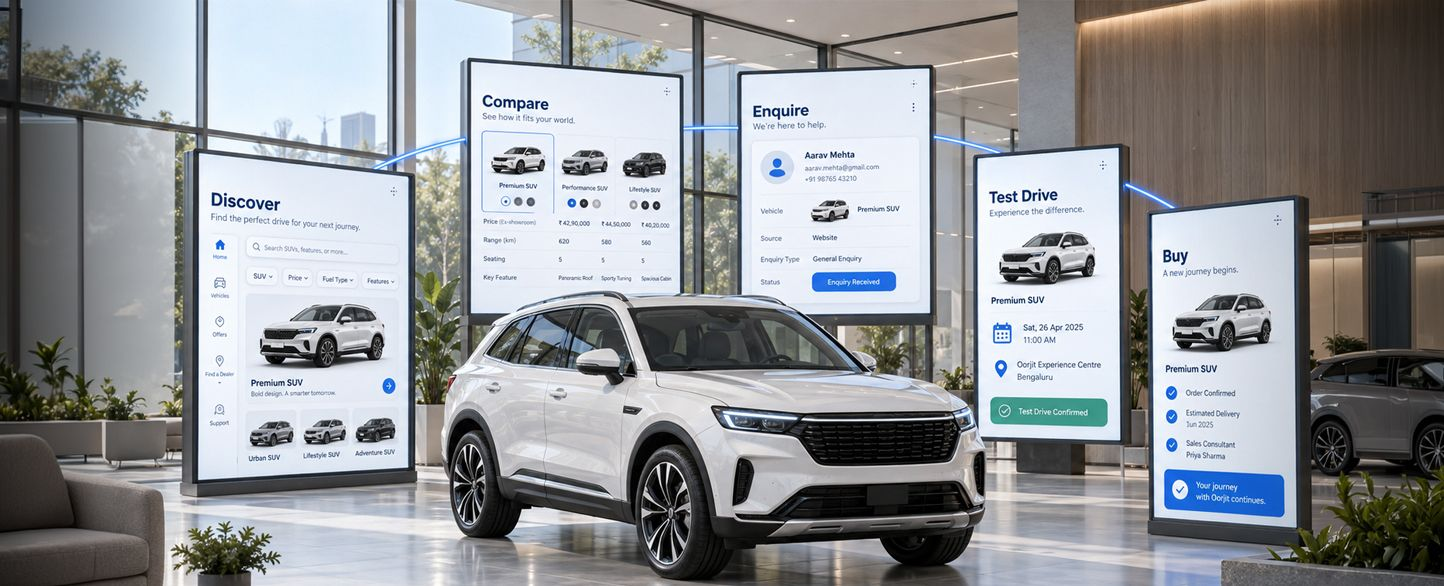
A customer enquires about a test drive on WhatsApp, then calls the showroom days later and has to repeat everything. The sales agent has no record of the conversation, and the lead goes cold.
This happens when WhatsApp, email, SMS, and live chat run as separate tools. CRM integration solves this by connecting every customer interaction to one shared system.
With a CRM-integrated omnichannel platform, sales and support teams can see the full customer history, follow up with context, and prevent leads from falling through the gaps.
This article explains how CRM integration works, why it matters for businesses in Singapore and Indonesia, and how it supports sales, support, automation, and AI-powered messaging.
What Is CRM Integration in an Omnichannel Communication Platform?
CRM integration is the process of connecting your customer relationship management system to your communication channels so that data flows automatically between them. In an omnichannel communication platform, this means every message sent or received via WhatsApp, email, SMS, or chat is linked to the corresponding customer record in the CRM in real time.
An omnichannel communication platform brings all your customer-facing channels into a single interface. If you're new to the concept, our guide on omnichannel customer communication platforms for automotive retail provides a detailed overview of how these platforms connect customer interactions across sales, service, and support.
Agents no longer switch between five different tools to respond to customers. Everything is managed from one place. CRM integration adds the intelligence layer: it tells your team who the customer is, what they have purchased, where they are in the sales pipeline, and what was discussed in previous conversations.
Together, these two systems create a unified communication and data environment that removes the guesswork from customer interactions.
What customer data should an omnichannel communication platform sync with CRM?
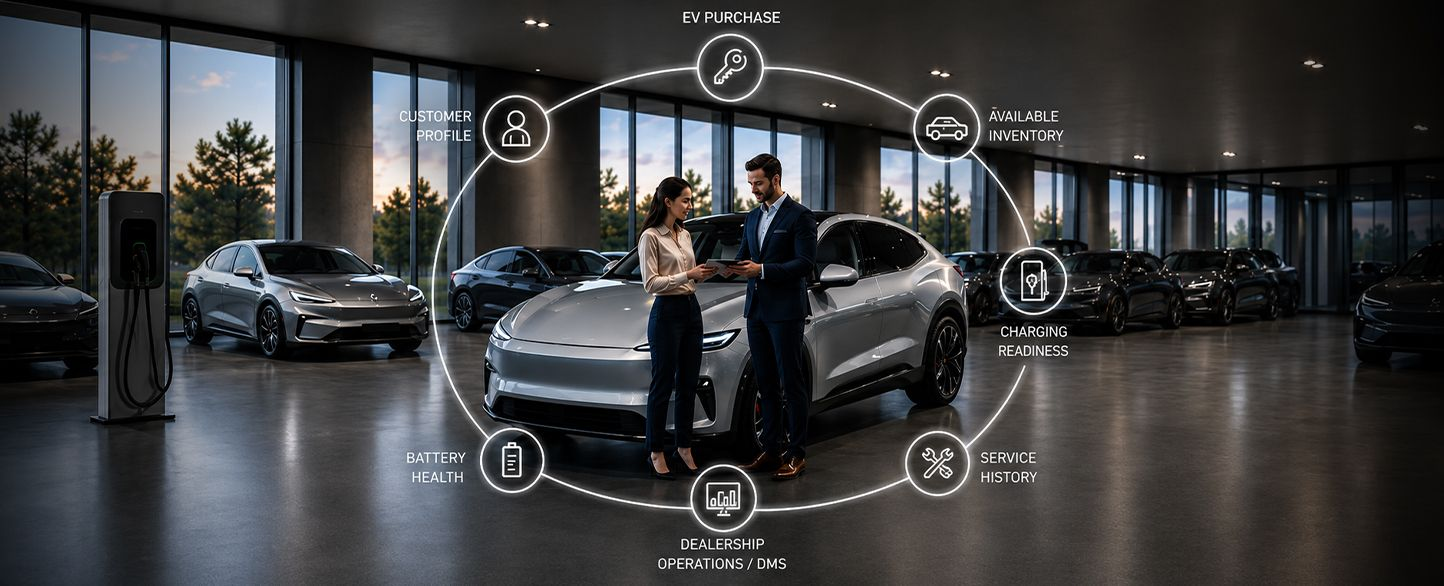
At a minimum, the sync should cover contact records, the full conversation history across all channels, the current deal stage, the preferred communication channel, and response timestamps. For automotive businesses, this should also include vehicle interest, test drive bookings, service history, and follow-up schedules.
What Is the Difference Between CRM Integration and Omnichannel Communication?
These two terms are related, but they serve different functions.
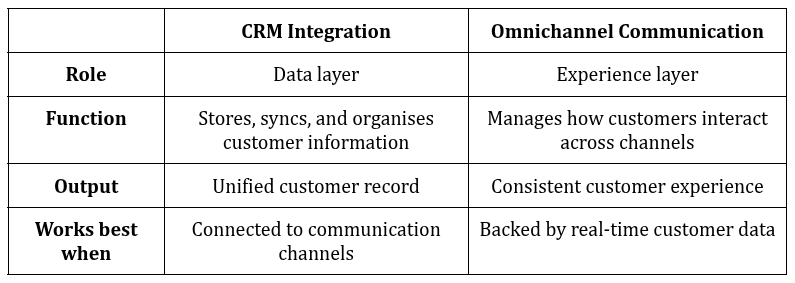
Think of it this way: omnichannel communication is the road network, and CRM integration is the navigation system. The roads connect your channels. The navigation tells you where the customer has been, where they are now, and the best way to reach them next.
Without CRM integration, your omnichannel platform is just a multi-channel inbox. With it, every conversation becomes part of a larger, connected customer data synchronization system that drives better decisions across the entire customer lifecycle.
How Does an Omnichannel CRM Create a Single Customer View?
A single customer view, sometimes called a 360-degree customer view, means that every team member viewing a customer record sees the same complete picture, regardless of which channel the customer used to make contact.
When a prospect messages your dealership on WhatsApp to ask about financing options, that conversation is logged against their CRM profile. When they later email to request a brochure, that is added to the same profile. When they call to book a test drive, the agent answering already knows the full history before picking up the phone.
This is what customer journey mapping looks like in practice. It is not a diagram on a whiteboard. It is a live, data-driven record of every touchpoint a customer has had with your business, built automatically through customer data synchronization across every channel.
How does CRM integration prevent duplicate customer records?
A CRM-integrated platform uses contact matching logic to identify when an incoming message belongs to an existing customer, whether they are reaching out via a new channel or a different phone number. Duplicate records are merged automatically, keeping your database clean and ensuring agents always work from a single, accurate profile.
Why Do Businesses Need a Unified Customer Conversation History?
Businesses need a unified conversation history because scattered communication makes teams lose customer context. Sales may not know about a recent complaint, and support may not know about an active sales discussion.
A unified history gives every team member the full picture across WhatsApp, phone, chat, and showroom interactions. This helps agents continue conversations smoothly, avoid repeated questions, and build customer trust.
For automotive businesses in Singapore and Indonesia, it is a core part of delivering a professional omnichannel customer communication experience.
How Does CRM Integration Improve Customer Communication?
CRM integration improves customer communication in three direct ways: it speeds up response times, it reduces missed follow-ups, and it ensures consistent messaging across your entire team.
How does CRM integration improve response time across communication channels?
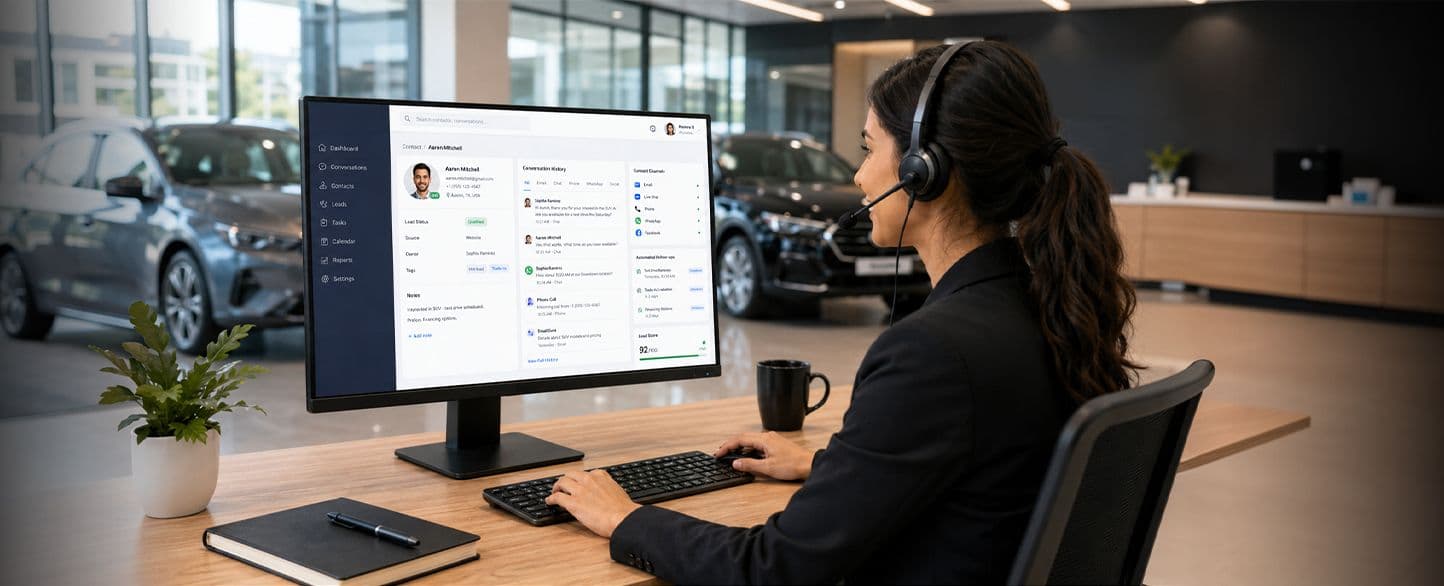
When an agent opens a conversation, the CRM data loads alongside it. They do not need to search for the customer record, check a separate system for deal history, or ask a colleague for context. Everything is visible in the same interface. This removes the internal friction that slows response times down.
Can CRM integration reduce missed customer follow-ups?
Yes. CRM integration allows you to set automated follow-up triggers based on customer activity or inactivity. If a prospect has not responded in 48 hours, the system flags it or sends an automated message. If a deal stage changes, the assigned agent receives a task. Nothing falls through the cracks because the system tracks every open thread automatically.
For omnichannel customer communication software serving Singapore businesses, where customer expectations around response speed are high, this level of automation is a competitive advantage.
How Does CRM Integration Help Manage WhatsApp, Email, SMS, and Chat in One Place?
CRM integration connects WhatsApp, email, SMS, and live chat to the same customer record through API-level syncing. When a customer sends a message on any channel, it appears in a unified inbox and is automatically linked to their CRM profile.
This gives agents a single screen to manage conversations, reply faster, view past interactions, and avoid switching between platforms. Every response is also logged in the CRM automatically.
This is especially important in Southeast Asian markets like Singapore and Indonesia, where WhatsApp is a primary customer communication channel, while email and SMS remain useful for formal updates, confirmations, and automated notifications.
For businesses evaluating the best CRM integration platform for Singapore or an omnichannel CRM platform for Indonesian businesses, managing WhatsApp at scale within a CRM-connected environment is often a key requirement.
How Does CRM Integration Help Sales and Support Teams Work Together?
CRM integration gives sales and support teams access to the same customer timeline. Sales can see past complaints, service updates, and support history before making an outreach, while support can view deal details and promises made during the sales process.
This shared visibility reduces internal gaps and improves follow-ups. Deal stages in the CRM can also trigger automated actions, such as sending a post-purchase WhatsApp onboarding message or prompting sales to discuss a trade-in after a service booking.
For automotive dealerships in Singapore, this helps create a smoother customer journey across sales, service, and support.
How Does CRM Integration Support Personalized Customer Communication?
Personalisation in customer communication is not about using someone's first name in a message. It is about sending the right message, through the right channel, at the right stage of the customer journey.
CRM integration makes this possible by giving your communication platform access to the data it needs to segment and target accurately. You can group customers by vehicle interest, purchase stage, service history, or last interaction date. You can then trigger messages that are relevant to where each customer actually is, not where you assume they might be.
How does CRM integration improve lead nurturing across channels?
Lead nurturing becomes channel-aware with CRM integration. If a prospect engages most on WhatsApp, your nurture sequence prioritises WhatsApp. If they open emails but ignore messages, the system adjusts. This kind of adaptive nurturing is only possible when your communication platform is reading from live CRM data.
For automotive businesses, personalised use cases include post-test drive follow-ups with financing options, service due reminders sent via the customer's preferred channel, and model launch notifications targeted at customers who previously enquired about similar vehicles.
Businesses evaluating an omnichannel customer engagement platform in Indonesia or Singapore CRM software for retail and e-commerce should prioritise platforms that support dynamic segmentation and channel-specific personalisation out of the box.
How Does CRM Integration Help Track the Full Customer Journey?
CRM integration automatically logs every customer interaction against one record, making customer journey tracking easier and more accurate. Teams can see how a customer moved from a Facebook ad to a WhatsApp enquiry, test drive, email follow-up, and final purchase.
This helps dealerships understand which channels convert, where customers drop off, and when follow-up is needed. It also improves post-sale visibility, including service bookings, upsell responses, and future upgrade opportunities.
For automotive businesses, this creates a more proactive customer journey built on complete, connected data.
Can CRM Integration Automate Customer Communication Workflows?
Yes. CRM integration automates communication by using CRM data as triggers. When a deal stage changes, a follow-up message can be sent. When a service booking is confirmed, WhatsApp or SMS reminders can go out automatically.
For automotive businesses, this can include test drive reminders, re-engagement messages for inactive leads, post-purchase check-ins, service due reminders, and escalation alerts for high-value leads.
This reduces manual follow-up work and ensures customers receive timely communication at every stage.
How Does CRM Integration Support AI Chatbots and Automated Messaging?
CRM integration helps AI chatbots move beyond generic replies by giving them access to customer context. The chatbot can identify returning customers, refer to past enquiries, confirm service bookings, or provide updates based on CRM data.
For high-volume markets like Indonesia, this reduces pressure on human agents by handling routine queries automatically. When escalation is needed, the agent receives the CRM record and chat history together, so the customer does not have to repeat details.
This makes AI-powered messaging more useful across omnichannel customer engagement platforms in Indonesia and Singapore.
What Are the Key Features of a CRM-Integrated Communication Platform?
When evaluating platforms, these are the features that determine whether the integration is genuinely useful or just a surface-level connection:
Unified inbox across WhatsApp, email, SMS, and chat: All channels managed from one interface, with every conversation linked to the corresponding CRM record.
Real-time CRM data sync: Customer records update the moment an interaction occurs. No delays, no manual imports.
Automated workflow builder: Visual tools to set up triggers, conditions, and actions without needing a developer.
Customer conversation history and timeline: A complete, chronological record of every interaction across every channel, visible to the whole team.
AI chatbot with CRM context: Chatbot responses informed by live customer data, not just scripted FAQs.
Role-based access for sales and support teams: Teams see what they need to see. Sensitive data is protected. Workflows stay clean.
Analytics and reporting dashboard: Track response times, resolution rates, channel performance, and pipeline activity from one reporting view.
Duplicate contact detection and merge: Automatic identification and consolidation of duplicate records to keep the CRM accurate.
For businesses evaluating the best CRM integration platform for Singapore or exploring omnichannel CRM solutions for Singapore startups and growing teams, these eight features represent the minimum viable requirement for a platform worth investing in.
Conclusion
CRM integration turns omnichannel communication from a set of disconnected tools into one coordinated customer system. It helps businesses reduce missed leads, avoid repeated customer explanations, improve follow-ups, and give sales and support teams the context they need to act faster.
For businesses in Singapore and Indonesia, where WhatsApp, email, SMS, and chat all play important roles, a CRM-integrated platform can make customer communication more consistent, personalised, and scalable.
Oorjit helps automotive businesses unify CRM, customer conversations, automation, and omnichannel engagement in one connected platform. Book a demo to see how Oorjit can support your customer communication strategy.
FAQ
Q: How do I know if my business needs a CRM-integrated communication platform?
A: If your sales and support teams are managing customer conversations across WhatsApp, email, SMS, and chat using separate tools, you likely need CRM integration. Key signs include missed follow-ups, duplicate customer records, slow response times, and no shared view of the customer journey across departments.
Q: Is CRM integration suitable for small and mid-sized businesses or only large enterprises?
A: CRM integration is suitable for businesses of all sizes. Small and mid-sized businesses in Singapore and Indonesia benefit significantly because it replaces multiple disconnected tools with one unified platform, reducing manual work and improving response times without requiring a large team or complex technical infrastructure.
Q: How does CRM integration handle customer data privacy and compliance?
A: A well-built CRM-integrated platform centralises customer data with role-based access controls, audit trails, and encrypted data storage. For businesses in Singapore and Indonesia, look for platforms that comply with PDPA and local data protection regulations to ensure customer information is handled securely across all communication channels.
Q: How does CRM integration sync data in real time across multiple channels?
A: CRM integration uses API connections to push and pull data between your communication channels and the CRM instantly. When a customer sends a WhatsApp message, their contact record, conversation history, and deal stage update automatically, ensuring every team member sees the same accurate information without manual data entry.
Q: How does CRM integration change the way sales and support teams handle daily tasks?
A: Sales teams gain instant access to full conversation history before following up, eliminating repeated questions to customers. Support teams see open deals and purchase history when handling service requests. Both teams work from a shared customer timeline, reducing handover friction and improving the overall speed and quality of communication.
Q: What measurable improvements can businesses expect after integrating CRM with their communication platform?
A: Businesses typically see faster first response times, higher lead conversion rates, fewer missed follow-ups, and improved customer satisfaction scores. Teams also report reduced time spent on manual data entry and better visibility into pipeline activity, making it easier for managers to track performance and identify gaps across communication channels.