For decades, large automotive dealer groups have held a structural advantage over smaller and regional players. That advantage was never really about better cars or better salespeople. It came from infrastructure: centralized customer databases, standardized processes, connected inventory, enterprise reporting, and dedicated technology teams that smaller dealerships simply could not fund on their own.
That gap is narrowing. Cloud-based automotive platforms, connected dealership systems, open APIs, and automation have made many of these capabilities accessible without dealerships needing to build enterprise IT infrastructure from scratch. A growing dealership no longer needs to match the physical scale of a large group to compete effectively with one.
What it does need is comparable operational visibility, comparable customer responsiveness, consistent processes, connected inventory, and the ability to scale without every new branch becoming a separate operational silo. This article looks at how that competitive gap is closing, where technology genuinely helps, and where it does not.
Why Do Large Dealer Groups Traditionally Operate More Efficiently?
Before discussing technology, it helps to understand the structural advantage large dealer groups have relied on.
Large groups can maintain a single view of customer, lead, purchase, vehicle, and service information across every location they operate, rather than each branch keeping its own separate records. This alone changes how consistently a business responds to customers.
They can also enforce standardized processes. Lead qualification, quotation, approvals, vehicle delivery, service, and follow-up tend to follow the same defined workflow regardless of which branch a customer walks into. A customer in one city gets roughly the same experience as a customer in another.
Inventory visibility works the same way. Management and sales teams can see stock availability across every location instead of treating each branch as an isolated pool of vehicles. If a customer wants a specific model and it happens to be sitting at a different branch, that inventory is still visible and still sellable.
Large groups also have far more visibility into their own performance. Management can compare locations, salespeople, inventory turnover, campaigns, models, conversion rates, and after-sales activity side by side, which makes it easier to spot problems early and act on them.
None of this happens by accident. Large groups historically have had more capacity to fund the software, integrations, infrastructure, and specialized IT teams needed to make it work. The takeaway worth holding onto is that the competitive gap is usually an operational infrastructure gap, not simply a difference in dealership size.
What Makes Dealership Digital Transformation Different in Emerging Markets?
In many growing automotive markets, dealership networks expand faster than the systems supporting them. A business can open a second, third, or fourth branch while important processes are still tracked in spreadsheets that live on one person's laptop.
Customer interactions arrive through WhatsApp, phone calls, email, a website form, and walk-in visits, often without any single record tying them together. Sales and after-sales frequently operate as separate worlds with little shared visibility. Different branches, run by different managers, tend to develop their own ways of doing things, which means customer information ends up fragmented across the business.
Internal IT resources are usually limited, which makes group-wide reporting difficult to build and inventory information difficult to consolidate. It is also common for dealerships to have adopted several different software products at different stages of their growth, none of which were designed to work together.
The underlying issue is that a dealership's commercial maturity can grow faster than its technology maturity. A business may already have multiple locations, high enquiry volumes, significant inventory, and several departments, while still relying on processes that were originally designed for a much smaller operation. That mismatch creates a scalability problem long before it becomes visible in the sales numbers.
How Does Technology Change the Competitive Equation?
This is where the real opportunity lies for growing dealerships. The pattern across each area below is consistent: an operational problem exists, a technology capability addresses it, and a measurable operational outcome follows.
Centralizing Leads and Customer Conversations
Enquiries arrive through dealership websites, digital advertising, phone calls, email, WhatsApp, showroom visits, and test drive requests. When these channels are not connected, conversation history gets lost, leads get duplicated, follow-up gets delayed, and the business ends up depending too heavily on individual salespeople remembering what was discussed and with whom.
Connected customer and lead management brings all of this into one customer record, with source attribution, conversation history, an assigned salesperson, a clear lead stage, the next required action, and follow-up status all in one place. The outcome is that smaller dealerships can deliver faster and more consistent lead management without needing a large centralized business development center to do it.
Managing Inventory Across Multiple Locations
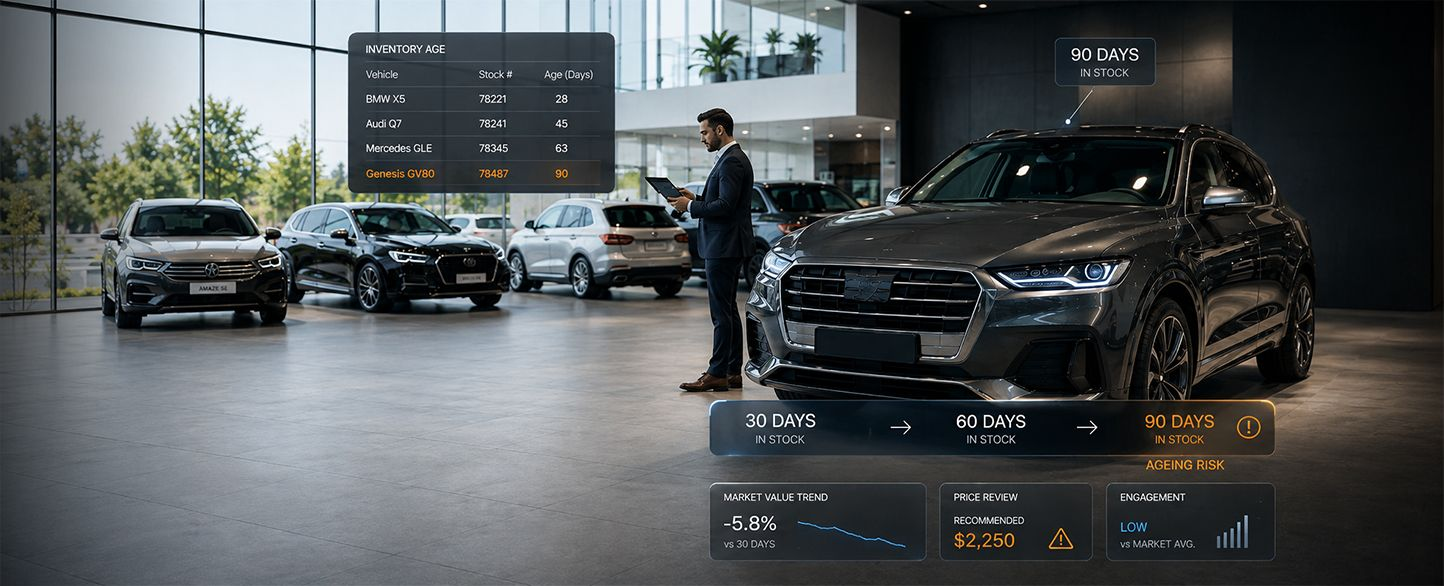
As a dealership network grows, inventory visibility becomes harder to maintain. Technology addresses this by giving sales and management teams visibility into vehicle availability, branch location, model and variant detail, reservation status, inventory aging, vehicle transfers, and stock movement.
The important shift here is that dealership locations no longer need to function as isolated pools of inventory. A salesperson at one branch can see and sell stock sitting at another. The outcome is a broader inventory network for sales teams and better control over aging and vehicle movement for management.
Standardizing Sales Processes Across Dealership Locations
Growing businesses often end up with different processes at different branches, simply because each location developed its own habits over time. Connected dealership systems make it possible to define consistent stages for lead qualification, test drive booking, quotation, finance enquiry, approvals, booking, delivery, and follow-up.
Technology does not create the process itself. Management still has to decide how the dealership should operate before a system can enforce it. Once that is defined, management can compare branch performance using consistent data, rather than comparing fundamentally different workflows that were never designed to be measured against each other.
Extending the Customer Journey Beyond the Physical Showroom
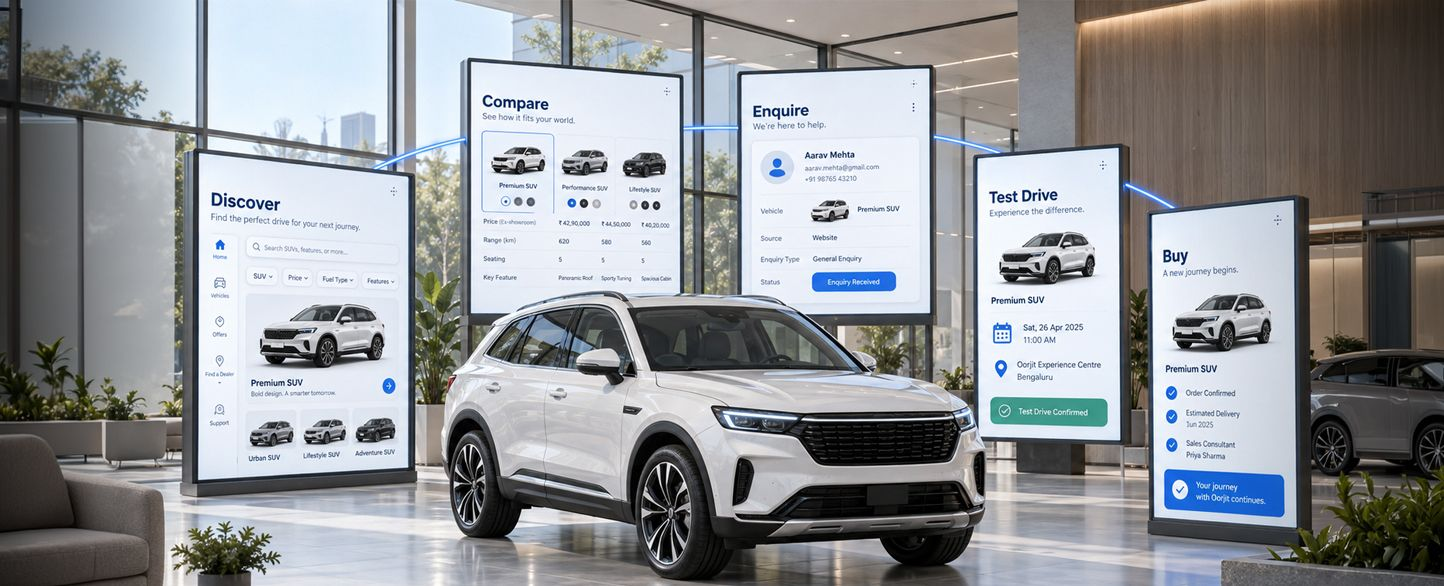
Customer expectations have shifted toward digital discovery and engagement, and this matters directly for competitive positioning. Online inventory discovery, vehicle comparison, test drive booking, finance enquiries, trade in enquiries, and online reservations all reduce a dealership's dependence on physical showroom footprint to acquire and engage customers.
A dealership with fewer branches than a large competitor can still reach the same customer base if its digital journey is well connected. Customer acquisition becomes less tied to how many showrooms a dealership operates.
Connecting Vehicle Sales With After Sales
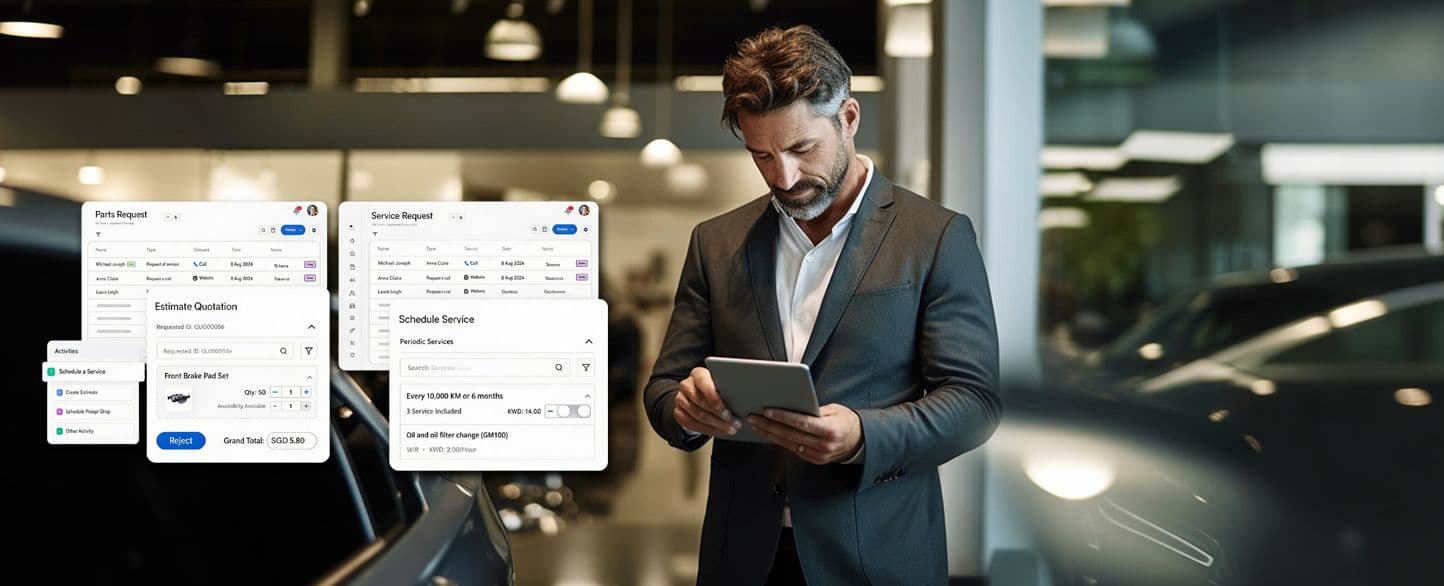
Many dealerships treat every customer interaction as a fresh acquisition, even when that customer bought a vehicle from them years earlier. Connected systems change this by maintaining vehicle ownership information, purchase history, service history, maintenance schedules, service reminders, and warranty information in one continuous record.
This allows a dealership to manage the relationship across the full ownership lifecycle instead of resetting to zero every time a customer interacts with a different department. The result is stronger retention and more repeat business from an existing customer base that might otherwise go unrecognized at the point of their next purchase.
Giving Management Faster Operational Visibility
Rather than making broad claims about data-driven decision-making, it helps to look at what dealership management actually needs visibility into: lead response time, lead conversion, pipeline movement, salesperson performance, inventory aging, branch performance, service activity, customer retention, and campaign performance.
The real value of real-time reporting is reducing the delay between a problem occurring, management identifying it, and corrective action being taken. A growing dealership that can see this in near real time can maintain management control without needing to increase manual reporting effort at the same rate its business is growing.
Where Does Oorjit Fit Into a Connected Dealership Technology Model?
Oorjit's role in this shift is less about being a single tool and more about connecting the functions described above into one operational foundation.
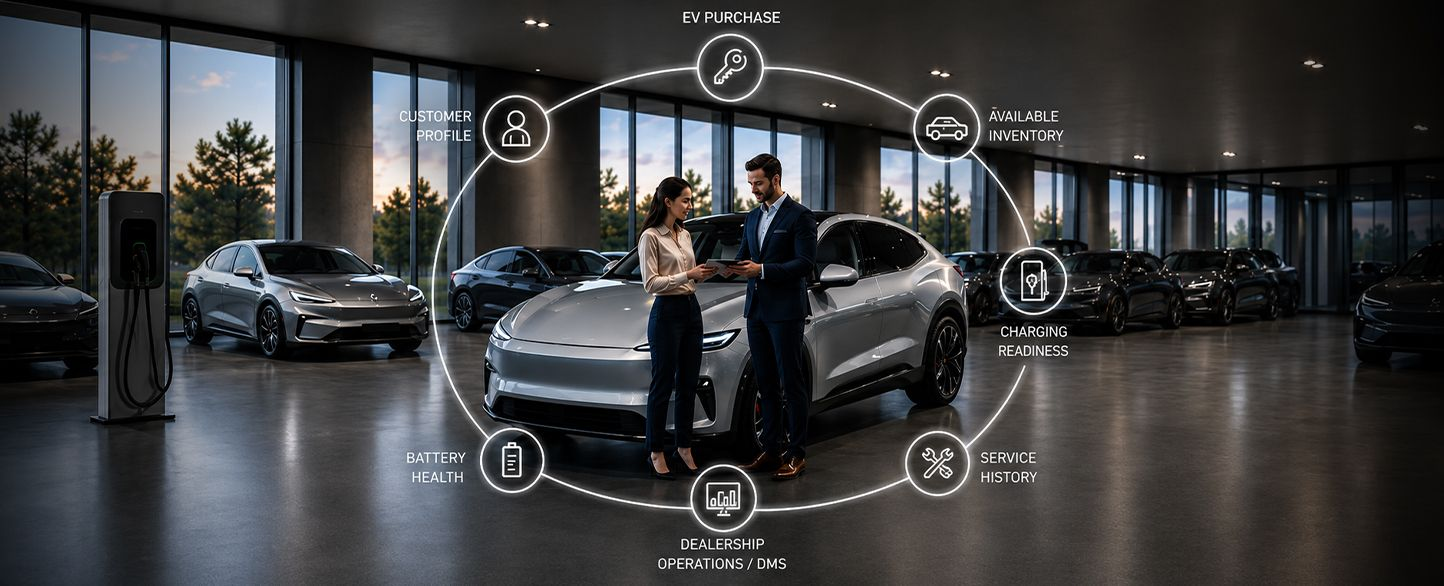
On the customer side, a connected CRM environment helps dealerships maintain consistent records of customer information, enquiries, interactions, salesperson ownership, and sales progress, rather than letting that information scatter across individual devices and personal notes.
On the operational side, DMS connectivity reduces the separation between customer-facing sales activity and core dealership operations, so that what happens in the showroom and what happens in the back office are informed by the same data rather than two disconnected systems.
Inventory visibility improves similarly. Centralized inventory information supports dealerships managing multiple locations by giving a clear picture of vehicle availability, movement, and stock status across the network rather than branch by branch.
Automation plays a supporting role once processes have been standardized. Relevant examples include lead assignment, customer follow-up, reminders, appointment communication, service communication, and internal workflow actions.
Automation applied to a well-defined process saves time. Applied to an undefined one, it mostly just speeds up the confusion.
Reporting brings this together by giving management visibility across sales activity, lead management, inventory, branch performance, and customer activity, so that oversight does not depend on someone manually pulling numbers from five different places.
As dealerships expand into additional branches, this same foundation extends with them, so growth does not mean building a new technology environment for every new location. Oorjit's relevance to this topic ultimately comes down to helping dealerships connect customer acquisition, CRM, sales, inventory, dealership operations, after-sales, and reporting into one system, to reduce fragmentation rather than add another disconnected tool to the stack.
Why Have Cloud and SaaS Changed the Economics of Dealership Technology?
Traditionally, enterprise-level capability came with an enterprise-level cost. Dealerships needed server infrastructure, internal IT administration, large upfront implementation budgets, and additional infrastructure every time a new location opened.
Cloud-based delivery has changed the calculation. Subscription-based access, centralized software updates, remote access, easier multi-location deployment, and API connectivity all lower the barrier to entry considerably.
It is worth being precise here rather than overselling the point. SaaS is not automatically cheaper than an on-premises alternative in every scenario. The stronger argument is that it reduces the infrastructure barrier and makes it easier for a dealership's technology capacity to scale alongside its actual business growth, rather than requiring a large capital investment ahead of that growth.
Why Buying More Dealership Software Is Not Digital Transformation
This is worth stating plainly, because it is where many dealerships lose momentum after their initial technology investment.
Poor data quality undermines any system. Incomplete, duplicated, or inaccurate customer and vehicle records reduce the usefulness of even the most capable platform. Low staff adoption has the same effect. If employees continue managing customers through personal spreadsheets or informal messaging, the central platform never gets the complete picture it needs to be useful.
Disconnected systems create a similar problem from a different angle. A dealership can own several sophisticated applications and still suffer from fragmented operations if information does not actually move between them. Undefined processes compound this, since no software can standardize a workflow that management has never properly defined. And automation applied to an inefficient process does not fix that process. It simply accelerates it.
The real competitive advantage comes from combining technology with reliable data, defined processes, genuine integration, and employee adoption, not from the number of applications a dealership happens to be running.
What Should Growing Dealerships Digitize First?
A practical rollout tends to work better in sequence than all at once.
The first stage is establishing reliable digital records for leads, customers, vehicles, inventory, and transactions, since reliable information has to exist before sophisticated automation is introduced on top of it. The second stage is connecting core systems, including the website, CRM, DMS, inventory, communication channels, and service, with the specific objective of reducing duplicate information and closing system silos.
The third stage is standardizing workflows for lead ownership, qualification, quotation, follow-up, bookings, approvals, vehicle delivery, and service communication, so that every branch is operating from the same playbook. The fourth stage is automating the processes that are now repeatable, such as lead routing, reminders, appointment confirmations, customer follow-ups, service reminders, and reporting workflows.
The fifth stage is using the resulting data to optimize operations by identifying slow lead response, conversion bottlenecks, aging inventory, weak branch performance, customer drop-off, and retention opportunities. The sixth and final stage is scaling the established foundation across additional locations, brands, departments, and markets, without treating each expansion as a fresh technology project.
What Matters When Selecting Dealership Technology?
Rather than chasing a "best software" list, dealerships evaluating new technology should look closely at automotive-specific workflows, CRM and DMS connectivity, integration with existing systems, API capability, inventory connectivity, multi-location support, customer data management, workflow automation, reporting capabilities, access controls, scalability, implementation requirements, user adoption requirements, and ongoing support.
The central buying question worth asking is straightforward: will this platform reduce operational fragmentation as the dealership grows, or will it become another disconnected system sitting alongside the ones already in use?
Competing Through Operational Capability, Not Size
Large dealer groups will keep the advantages that come with scale. But scale alone does not guarantee a faster customer response, better inventory utilization, or stronger operational control, and that is precisely the opening growing dealerships have.
Dealerships that build connected customer data, standardized workflows, shared inventory visibility, integrated customer journeys, after-sales continuity, and clear management visibility put themselves in a genuinely competitive position, regardless of how many branches they operate. Oorjit is built to help dealerships create exactly this kind of connected environment, bringing customer, sales, inventory, and after-sales data together on one foundation that can grow with the business rather than holding it back.
If your dealership is managing growth across multiple locations with disconnected tools and fragmented customer data, talk to Oorjit about building a single connected foundation for sales, inventory, and after-sales operations.
FAQs
Q: How can smaller dealerships compete with large dealer groups?
A: Smaller dealerships compete most effectively through operational agility rather than physical scale. Connected customer data, faster lead response, clear inventory visibility, and standardized workflows across branches let a smaller dealership match the responsiveness of a much larger competitor.
Q: What technology should a growing dealership implement first?
A: Reliable lead, customer, inventory, and transaction data should come before advanced analytics or automation. A dealership that automates on top of incomplete or inconsistent data usually ends up scaling the same problems it was trying to solve.
Q: When should a dealership replace disconnected software systems?
A: Signs worth acting on include duplicate data entry across systems, inconsistent customer records between departments, limited visibility across branches, separate inventory data that does not reflect the full network, heavy reliance on manual reporting, and growing complexity every time systems need to be connected or updated.
Q: Is an integrated automotive platform better than using separate dealership systems?
A: It depends on how well those separate systems are governed. Specialist tools can work well when integrations are strong, and data governance is disciplined. An integrated platform like Oorjit becomes increasingly valuable once disconnected tools start creating duplicated work, incomplete customer information, or poor visibility across dealership functions, which is a common outcome as dealership networks grow.