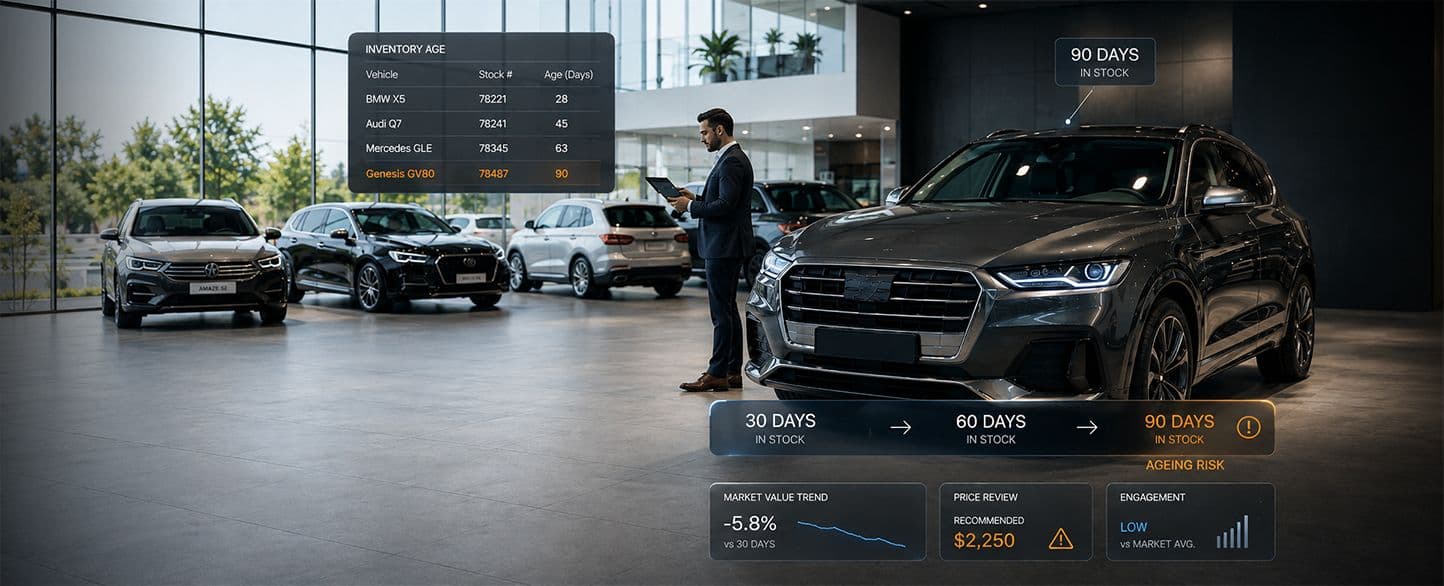
Two vehicles can arrive at the same dealership in the same week, sourced through similar channels, priced by the same manager. One sells within ten days. The other is still on the lot three months later, after two price cuts and a growing sense among the sales team that something is wrong with it. Nothing about the second car necessarily changed between arrival and day ninety. What changed was everything that happened, or failed to happen, in between. Understanding why cars actually age on a lot means looking well before the point where a vehicle gets labeled a problem.
What Counts as Aged Inventory?
Dealerships typically track a vehicle's days in stock, sometimes called days on lot, and group units into ageing bands, commonly 0 to 30, 31 to 60, 61 to 90, and 90 plus days. Aged inventory refers to vehicles that remain unsold beyond the dealership's normal target selling period, most often flagged once they cross the 30 or 45 day mark for used stock.
These thresholds are not universal. A new car dealership benchmarking against an industry average of 75 to 80 days' supply operates on a very different clock than a used car department, where many managers treat a unit passing 45 days in inventory as a sign that something in the acquisition or pricing decision went wrong. Luxury vehicles, economy models, EVs, and commercial vehicles all carry different natural selling windows, and multi-brand dealer groups often need brand-specific or even branch-specific thresholds rather than one blanket rule.
Why Does a Car Actually Sit Unsold?
Ageing is rarely one problem. It is usually several smaller decisions compounding, most of them made long before the vehicle ever felt "old."
The Vehicle Was Priced Against Cost Instead of the Market
The most common root cause has nothing to do with the vehicle itself. It has to do with what the dealership paid for it, or believes it needs to recover. A car acquired through an allowed trade-in, an aggressive auction bid, or an expensive reconditioning job carries a cost basis that may not match what buyers in that specific market are willing to pay right now.
This creates a quiet standoff. The dealership prices toward its cost rather than toward the market, hoping demand catches up. It usually does not. And because correcting the price immediately exposes the margin problem, that correction often gets delayed, which is precisely the mechanism that turns a slow-moving unit into an aged one.
The Dealership Acquired the Wrong Vehicle for Its Local Market
A vehicle can be desirable in the abstract and still be the wrong fit for where it landed. Trim level, drivetrain, mileage band, colour, and even fuel type interact with local buyer expectations in ways that are easy to miscalculate at acquisition. A well-specified diesel SUV might turn quickly in one city and sit for months in another where buyer preference has shifted toward petrol or hybrid variants. An EV's performance on the lot depends heavily on local charging infrastructure, incentive structures, and how familiar buyers in that specific catchment already are with electric ownership, factors that vary sharply between neighboring markets, let alone between countries.
This is an inventory mix problem, not a demand problem in the abstract. The vehicle may sell well elsewhere. It just was not acquired with this location's buyer in mind.
The Car Started Ageing Before Customers Could Even See It
Days in stock usually start counting from the moment a vehicle is acquired, not from the moment it is actually available for a customer to buy. Between those two points sits inspection, workshop time, parts availability, cosmetic repair, photography, and listing approval. Every day spent in that pipeline is a day consumed from the vehicle's most valuable selling window, the early period when pricing power and buyer interest are typically strongest.
A vehicle that spends two weeks becoming retail-ready has effectively lost two weeks of its best chance to sell before a single customer ever saw it. That is not a reconditioning delay in the abstract. It is a direct transfer of selling days from the front of the cycle, where they are worth the most, to the back, where they are worth the least.
The Vehicle Exists in Inventory but Is Practically Invisible to Buyers
Availability and discoverability are not the same thing. A car can be sitting on the lot, fully listed, and still be functionally invisible to the buyers who would want it, because of incomplete photos, a thin specification sheet, missing finance information, or a description that reads identically to every other unit on the page. Buyers researching online are comparing dozens of similar listings quickly. A vehicle that fails to communicate what actually differentiates it- condition, history, standout features- gets scrolled past regardless of how good a fit it might have been.
New Arrivals Keep Getting Attention While Older Units Become Background Stock
Sales floors have a natural bias toward what just arrived. Fresh stock generates conversation, fresh marketing, and fresh customer questions. Older units, especially ones that have already failed to attract a buyer once or twice, quietly recede into the background of a salesperson's attention. This is not usually a deliberate choice. It is what happens when there is no structured routine forcing the team to revisit units that are already a few weeks old.
The result is a kind of feedback loop: a vehicle becomes less likely to sell partly because it has already failed to sell, and that failure reduces the internal attention it receives, which further reduces its chances.
The Market Changed While the Vehicle Was Sitting
Demand is not fixed at the moment of acquisition. Seasonal buying patterns, a competitor's new discount, an OEM incentive on a comparable model, a shift in fuel prices, or the announcement of a new model year can all change what a vehicle is actually worth in the market within a matter of weeks. The pricing and positioning that made sense when the car arrived may simply no longer make sense forty-five days later, independent of anything about the vehicle itself. Dealer groups operating across several regional markets or countries often see this most clearly, since the same model can be moving at a healthy pace in one location while stalling in another due to nothing more than local timing.
What Does an Unsold Car Actually Cost a Dealership?
The cost of aged inventory is not one fixed number. It is the combined effect of financing, depreciation, operating expenses, and lost opportunity.
Financing Cost
Floorplan-funded inventory continues to accrue interest until it is sold. The daily cost varies by vehicle value, interest rate, and financing terms. Industry estimates often place total holding costs around $32 to $48 per vehicle per day when financing, depreciation, insurance, and lot expenses are considered together.
Depreciation and Market Movement
A vehicle can lose retail value while sitting, especially in the used market. As newer or cheaper comparable vehicles enter the market, the achievable selling price may fall even if the vehicle itself has not changed.
Operating Carrying Costs
Insurance, storage, cleaning, battery maintenance, and repeated merchandising updates all add to the cost of keeping a vehicle in stock.
Opportunity Cost
Capital tied up in an unsold vehicle cannot be used for faster-moving inventory. The vehicle also occupies lot space, borrowing capacity, and management attention, which is why inventory turn is often as important as gross profit per unit.
How Does Ageing Compound Over Time?
Inventory ageing works more like a feedback loop than a linear clock, with each delay making the next correction more expensive.
A vehicle enters stock with an expected margin, but if demand is weaker than anticipated, pricing adjustments may be needed. By the time those changes happen, financing costs and depreciation have already started eroding profitability. As a unit moves beyond 30, 60, and 90 days, dealerships may face deeper discounts, branch transfers, wholesaling, or reduced gross profit.
The key risk is waiting too long to protect margin. Delayed repricing can increase holding costs while the vehicle continues to lose market value, making recovery harder over time.
What Signals Should Dealerships Watch Before a Car Becomes a Problem?
Days in stock often confirms a problem that has already been developing for weeks. Earlier signals can provide more useful warnings.
High listing views with few enquiries may indicate a pricing or specification mismatch. Enquiries that fail to become appointments can point to issues further down the sales funnel. Repeated price reductions may also signal that the original pricing or demand assumptions were inaccurate.
For multi-location dealer groups, location matters too. A vehicle ageing at one branch may perform better at another, so cross-branch visibility can help identify transfer opportunities before the unit becomes heavily aged.
How Can Dealerships Prevent Inventory From Ageing in the First Place?
Prevention starts earlier than most ageing conversations acknowledge, generally before the vehicle is even acquired.
Buy with an exit strategy in mind
Before a vehicle is acquired, it is worth having a working view of the expected buyer, the realistic retail price, competing local stock, and the likely time to sale. Acquisition decisions made without that view are the ones most likely to produce ageing stock later.
Reduce the acquisition-to-listing gap
Faster reconditioning, photography, and appraisal workflows are not about operational speed for its own sake. They are about preserving as much of the vehicle's natural selling window as possible before it is even exposed to buyers.
Review pricing before a unit reaches its danger zone
Waiting until ninety days to acknowledge that the market has moved is the expensive version of this decision. Pricing reviews that respond to competitor movement, lead behavior, and inventory age as they happen tend to protect far more margin than reactive markdowns.
Treat multi-location inventory as one commercial pool
For dealer groups, a vehicle ageing at one branch should immediately raise the question of whether it would move faster elsewhere. Platforms such as Oorjit support this by giving dealership groups visibility into stock age, pricing, and availability across every branch, which helps surface these transfer decisions earlier. Technology does not undo a poor acquisition or a mispriced unit on its own, but it does help a dealership see the early signals sooner and act on them more consistently across locations.
Where Oorjit Fits Into This Picture
None of the causes covered above get solved by software alone. A vehicle acquired at the wrong price, or acquired for the wrong local market, is still a bad decision even with perfect visibility into it. What visibility does change is how quickly that decision gets noticed and corrected, and how consistently that correction happens across every branch rather than just the ones with an attentive manager.
Oorjit gives dealer groups a shared view of days-in-stock across every location, so a unit approaching its ageing threshold at one branch is visible to the group, not just to that branch's team. This is particularly relevant for the location-mismatch problem covered earlier: a vehicle that is genuinely slow-moving where it sits may simply be in demand two branches over, but that only becomes actionable if someone can see both stock positions at once.
The platform also surfaces repeated price reductions, listing gaps, and stock that has gone quiet on engagement, the kind of early signals that are easy to miss manually across a large inventory but straightforward to flag systematically. None of this replaces sound acquisition or pricing judgment. It shortens the distance between a vehicle starting to age and someone actually noticing.
Conclusion
Ageing inventory is usually a planning problem long before it becomes a discounting problem. The causes trace back to acquisition decisions, reconditioning speed, pricing discipline, and merchandising quality, all of which happen well before a vehicle is ever labeled aged. By the time a ninety-day unit shows up on a report, the commercial issue has typically been building for weeks. Dealerships that treat ageing as a signal to investigate the decisions upstream, rather than simply a stock problem to discount away, tend to protect far more margin over time. Oorjit supports earlier visibility across sales, inventory, and multi-branch operations, so ageing patterns surface while there is still room to act on them.
For dealer groups looking to see where ageing risk is building across their own locations, Oorjit's team can walk through what that visibility looks like in practice.
FAQs
Q: What is considered aged inventory in car dealerships?
A: Aged inventory refers to vehicles that remain unsold beyond a dealership’s expected selling window, often tracked in 30-, 60-, and 90-day brackets. Thresholds vary by dealership, vehicle type, and market.
Q: How much does an unsold car actually cost a dealership per day?
A: Costs vary based on vehicle value, floorplan interest, insurance, lot expenses, and depreciation. Industry estimates often range from about $30 to $48 per vehicle per day, though costs can be higher. The total cost over time is more important than a single daily figure.
Q: Can aged inventory recover value, or is it always a loss?
A: Aged inventory is not always a loss. Repricing, better merchandising, branch transfers, or suitable finance offers can improve its chances of selling. However, recovery becomes harder as holding costs and depreciation continue to increase.
Q: How does Oorjit help dealerships track ageing stock across locations?
A: Oorjit provides centralized visibility into inventory across branches, including days-in-stock tracking and ageing alerts. This helps dealer groups identify ageing vehicles earlier and make faster transfer, pricing, or stock-management decisions.