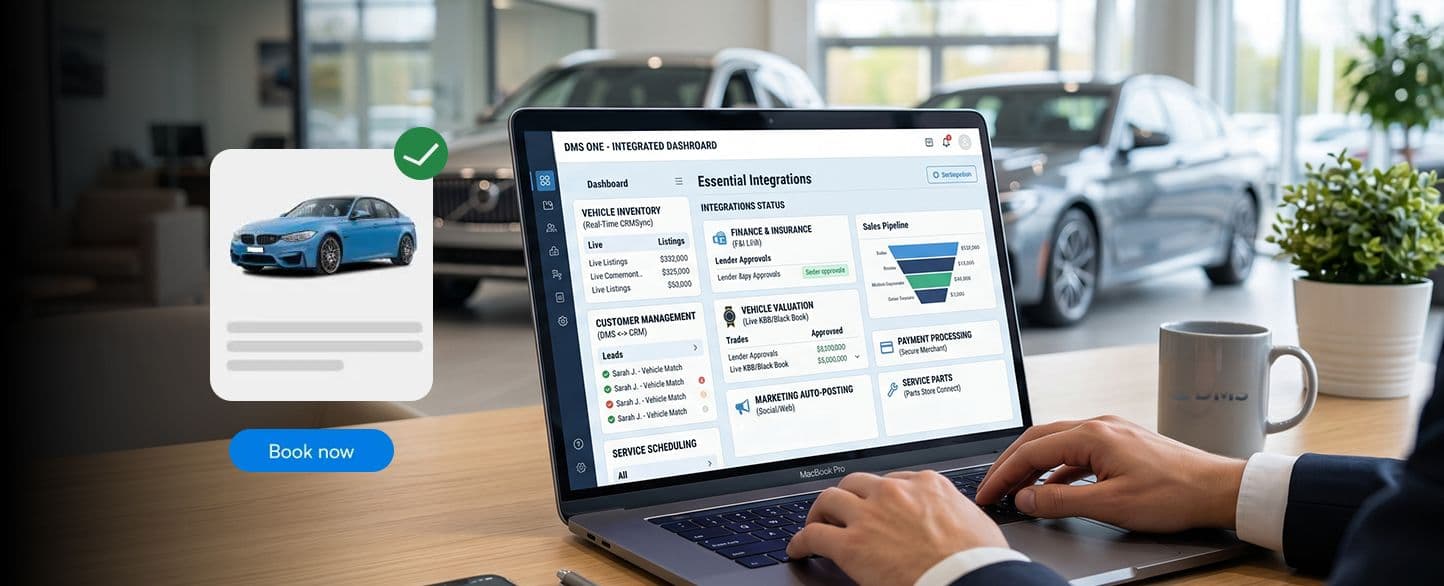
Every disconnected system in a dealership has a price. A CRM without live inventory data means a consultant quoting a vehicle sold yesterday. A finance desk re-entering deal details by hand leads to errors that surface weeks later during an audit. A service team with no visibility into purchase history means a generic interaction when a personalised one was possible. These failures are not dramatic. They are quiet, repeated, and cumulative, and across a month of operations, they add up to lost revenue, wasted hours, and missed opportunities.
The dealer management system sits at the centre of all of this. But a DMS is only as useful as its connections. A platform that manages data well internally but shares it poorly with surrounding systems creates a bottleneck rather than solving one
In this guide, we cover:
- The essential integrations every dealership management system should support
- How integrations improve operational efficiency and visibility
- Key technology requirements for scalable dealership operations
- What to evaluate when choosing or upgrading a DMS
- How connected systems reduce manual work and improve decision-making
If you are new to dealer management systems or evaluating one for the first time, it helps to understand what a DMS is designed to do before examining what it needs to connect to. Our guide to dealer management software core functions and business benefits covers the foundational capabilities that any DMS should deliver.
Why Integration Is the Backbone of a Modern Dealership
A modern dealership runs across several functional areas at once: inventory, sales, finance and insurance, service and parts, marketing, and customer communications. Each area has its own workflow and, in most cases, its own software. Without structured integration between these systems, data fragments, teams work with incomplete information, and the customer experience reflects that.
The operational cost is concrete. Sales staff who cannot see service history ask customers for information that the business already holds. Finance teams that manually re-enter deal details from the sales desk introduce errors that create accounting and compliance problems later. Parts managers on a disconnected system miss low-stock flags before they delay repairs and cost the workshop billable hours.
A connected dealership ecosystem solves this by ensuring every system involved in the customer lifecycle shares data in real time. A lead from a listing portal flows into the CRM automatically. A completed sale updates the inventory count immediately. A finished service job logs against the customer record and can trigger a follow-up without manual input. This is not an advanced capability. It is the operational baseline for a dealership running at full efficiency.
The depth of integration a DMS requires depends on the modules it includes natively. Platforms that consolidate more functions internally reduce the number of third-party connections needed to run a complete dealership operation, a point covered in detail in our guide to enterprise DMS features and modules.
CRM Integration: Connecting Sales and Customer Data
CRM integration is one of the most critical capabilities of a dealership management system because it ensures customer data remains connected across sales, service, and post-purchase interactions. Without integration, customer information becomes fragmented, limiting visibility into enquiry history, purchase records, service activity, and follow-up opportunities. Real-time, bidirectional data exchange allows dealership teams to access a complete customer profile, improve communication, and generate more accurate lifecycle insights.
Key Data That Should Sync Between DMS and CRM
- Incoming leads and source attribution
- Vehicle interests and configuration preferences
- Quotes, deal stages, and purchase history
- Vehicle delivery dates
- Post-sale service and maintenance records
Why CRM Integration Matters
- Gives sales teams a complete customer view in one place
- Improves follow-up and renewal tracking
- Eliminates duplicate data entry and manual reconciliation
- Supports accurate customer lifetime value reporting
- Enhances customer experience through connected interactions
A modern DMS should support native integrations or open API-based connectivity to avoid vendor lock-in and maintain seamless data flow.
Inventory Management and Multi-Channel Listing Sync
Inventory is the foundation of dealership operations, making accurate, real-time inventory data essential for both efficiency and customer trust. A dealership management system must synchronise inventory across all sales channels, including the dealer website, third-party listing platforms, and social commerce channels like Facebook Marketplace. Without proper sync, dealerships risk outdated listings, pricing inconsistencies, wasted leads, and poor customer experiences.
Key inventory integration capabilities include:
- VIN decoding for automatic vehicle specification updates
- Photo synchronisation across all listing platforms
- Real-time pricing updates from the DMS to all channels
- Automatic availability updates when vehicles are sold or reserved
- Centralised inventory visibility across multiple locations and channels
For dealerships handling large used-car inventories or multi-location stock, maintaining listings manually is inefficient and difficult to scale. Oorjit addresses this with real-time inventory synchronisation across dealer websites and supported listing channels. Any stock, pricing, or status changes made within Oorjit are instantly reflected across connected platforms, reducing manual effort and ensuring buyers always see accurate information.
F&I Software Integration: Streamlining Finance and Insurance
Finance and Insurance (F&I) is one of the most revenue-critical and process-intensive areas of a dealership. Every deal requires lender submissions, credit checks, compliance documentation, product presentations, and contract generation, all within tight timelines. Without integration between the F&I platform and the DMS, dealerships are forced to manually re-enter deal data, increasing delays, errors, and compliance risks.
A fully integrated F&I workflow allows sales data, including vehicle details, trade-in values, customer financial profiles, and pricing, to flow directly into the finance system. The platform can then manage lender routing, compliance documentation, e-contracting, and automatically sync completed contracts back into the DMS. For dealerships in the UAE and APAC regions, where finance operations must comply with local lending and consumer credit regulations, integrated and compliant document generation is both an operational and risk management requirement.
Key Benefits of F&I Integration
- Eliminates manual re-entry of deal and customer data
- Speeds up finance approvals and contract processing
- Reduces compliance and documentation errors
- Supports lender routing and e-contracting workflows
- Ensures completed financial data syncs automatically with accounting systems
- Improves operational accuracy and audit readiness
Accounting and ERP Integration
Accounting is one of the most error-prone areas in dealership operations when financial data is transferred manually between systems. A single vehicle sale involves multiple transactions, including trade-in valuations, finance reserve, F&I revenue, taxes, and service or reconditioning costs. Without integration between the DMS and accounting platform, manual data entry increases the risk of errors, delays, and reporting inconsistencies.
A modern dealership management system should support seamless accounting and ERP integration to ensure accurate financial reporting and operational efficiency. This is especially critical for dealer groups managing multiple locations, where consolidated reporting depends on real-time financial data synchronisation.
Key integration capabilities should include:
- Automatic deal posting from completed vehicle sales
- Accounts payable and receivable synchronisation
- Payroll and invoice data integration
- Parts and service billing updates
- Month-end reconciliation support
- Real-time financial reporting across single-site and multi-location operations
OEM Portal and Manufacturer Data Integration
Franchise dealerships rely on continuous data exchange with OEMs for warranty claims, parts ordering, incentive tracking, vehicle allocation, and compliance reporting. When managed manually, these processes create administrative overhead, increase the risk of errors, and can lead to delayed claims, missed incentives, and compliance issues.
A DMS with OEM portal integration enables real-time, structured data exchange between dealership systems and manufacturer platforms. Warranty claims can be submitted directly from the service module, parts orders can be triggered automatically, and sales registration data for incentive programmes can be transmitted instantly at deal completion.
In the UAE and APAC markets, where OEM and regulatory requirements differ across brands and regions, seamless manufacturer integration is essential for operational efficiency and compliance.
Key Benefits
- Reduces manual data entry and administrative workload
- Automates warranty claims and parts ordering
- Improves accuracy in OEM reporting and compliance
- Helps avoid delayed incentive payments and reporting errors
- Enables auditable and structured data exchange with manufacturers
Service and Parts Management Integration
Fixed operations, including the service workshop and parts department, contribute significantly to dealership profitability. However, many dealerships still operate these functions on systems disconnected from sales and customer management platforms. This creates operational inefficiencies, such as limited visibility into customer service history, disconnected service reminders, and manual parts availability checks during service bookings.
An integrated DMS helps unify these operations by connecting service, parts, and customer data within a single system. This improves workflow efficiency, enhances customer experience, and provides teams with complete operational visibility.
Key integration capabilities include:
- Appointment scheduling is linked to vehicle service history and manufacturer maintenance schedules
- Repair order (RO) management for tracking job status, technician allocation, and parts usage
- Real-time parts inventory visibility with automated low-stock alerts and reordering
- Automatic updates of completed service jobs into customer records and accounting systems
- Full customer and vehicle history access for service advisors during bookings
- Improved upsell opportunities, recall management, and personalised service recommendations
Digital Retailing and Online Buying Tool Integration
Online car buying has become a core part of the automotive purchase journey across the UAE and APAC markets. Buyers now expect to configure vehicles, calculate payments, estimate trade-ins, and progress deals online before visiting a showroom. However, digital retailing tools only deliver value when fully integrated with the dealership management system (DMS).
Without integration, the buying journey becomes fragmented. Sales teams may not see the customer’s online vehicle configuration, pricing may differ from live DMS data, and digitally progressed deals are often treated as basic enquiries. These gaps reduce efficiency and impact conversion rates.
A properly integrated DMS ensures:
- Real-time inventory and pricing accuracy across online buying platforms
- Trade-in valuations automatically linked to deal records
- Payment calculators synced with current finance rates
- Seamless handoff of online deals to the sales team with complete customer context
Oorjit supports integrated digital storefronts that connect online buying workflows directly with inventory, pricing, CRM, and sales operations. This allows dealerships to convert digital interactions into structured, sales-ready opportunities rather than disconnected leads.
Marketing and Lead Source Integration
Dealership marketing investments are spread across multiple channels, including Google Ads, Meta platforms, automotive marketplaces like AutoTrader, Cars24, and CarDekho, and dealer websites. Each channel generates leads with valuable source data that helps dealerships measure marketing ROI. Without DMS integration, this data is often lost, making it difficult to track which channels are actually driving sales and increasing customer acquisition costs.
With integrated lead source tracking, enquiries from every channel are captured directly within the DMS and linked throughout the sales lifecycle. This allows dealerships to connect outcomes such as test drives, bookings, and lost deals back to the original marketing source, creating accurate attribution and performance visibility.
Key Benefits of Marketing & Lead Source Integration
- Captures lead source data from all marketing channels
- Tracks sales outcomes against original enquiry sources
- Improves marketing attribution and ROI visibility
- Enables automated lead routing to sales teams
- Triggers follow-up workflows based on the deal stage
- Helps allocate marketing budgets based on actual sales performance
Communication and Messaging Tool Integration
Customer communication in automotive retail has increasingly shifted toward messaging platforms such as SMS, WhatsApp, live chat, and email. Across the UAE and APAC markets, customers often interact with dealerships through these channels before and after a purchase. The challenge arises when these conversations happen outside the DMS, creating fragmented communication records and limited customer visibility.
A properly integrated DMS ensures that all customer interactions are automatically logged against the customer and vehicle record. This gives sales teams complete conversation history, helps managers monitor deal progress, and enables automated workflows such as service reminders, satisfaction follow-ups, and renewal alerts.
Key benefits of communication tool integration include:
- Centralised customer communication history across channels
- Better sales follow-up and deal visibility
- Automated reminders and post-sale engagement workflows
- Reduced manual data transfer between platforms
- Improved auditability and customer experience
Reporting, Analytics, and Business Intelligence Integration
Dealership reporting that relies on spreadsheets is slow, error-prone, and often outdated by the time decisions are made. Manually combining sales, inventory, and service data delays response times in fast-moving dealership environments where pricing, inventory, and operational decisions need to happen quickly. An integrated DMS with built-in analytics eliminates this challenge by providing real-time visibility across key business functions.
A modern DMS should support:
- Real-time sales performance tracking by model, consultant, and sales channel
- Gross profit analysis by deal type and F&I product
- Inventory aging and days-to-sale reporting
- Workshop utilisation and service revenue insights
- Lead conversion tracking by source
- API and data export support for BI tools like Microsoft Power BI and Tableau
- Consolidated reporting for dealer groups without manual data compilation
Vehicle History and Inspection Tool Integration
For used car dealerships, vehicle history data has become a critical trust factor. Buyers across the UAE and APAC markets increasingly expect verified history reports and inspection records to be available directly within vehicle listings. Dealerships that provide this information upfront often achieve stronger buyer confidence and higher conversion rates.
Integrating vehicle history tools into the DMS ensures that reports from providers such as Carfax, AutoCheck, or regional equivalents are automatically pulled using the VIN when a vehicle is added to inventory. Inspection and reconditioning reports can also be linked directly to the vehicle record, making them accessible to both sales teams and buyers through dealership websites. Beyond improving transparency, structured history and inspection data also support:
- More accurate trade-in valuations
- Faster access to vehicle background information for sales teams
- Better documentation for handling post-sale disputes
- Improved listing credibility and buyer trust
API Architecture and Integration Flexibility: What to Look For
A DMS integration strategy is only as strong as its API architecture. Platforms built on closed or proprietary systems may support limited pre-built integrations, but they often make it difficult and expensive to connect with new tools as dealership requirements evolve. An open API architecture gives dealerships the flexibility to add integrations, automate workflows, and scale operations without depending entirely on the vendor’s development roadmap.
When evaluating a DMS, dealerships should assess:
- Availability of open REST APIs with detailed documentation
- Access to developer tools and sandbox testing environments
- Support for real-time webhook-based integrations
- Hidden per-integration costs that increase total ownership expenses
- Whether integrations are self-service or require vendor intervention
Key red flags include restricted API access, integration features locked behind premium pricing tiers, and vendors that do not publicly provide API documentation. These limitations can create long-term operational and switching costs as technology needs grow.
Conclusion
The integrations a DMS supports are not a technical detail. They are a business decision. A platform that connects well with the tools a dealership already depends on reduces friction, improves data accuracy, and gives every team member a clearer picture of the customer and the deal. A platform that does not create the same operational gaps it was meant to close.
For dealerships evaluating their options in the UAE and APAC markets, the integration architecture of any DMS under consideration should carry as much weight as its feature set. What the platform can do matters. What it can connect to determines whether those capabilities are ever fully used.
Oorjit is built to support connected dealership operations with open API architecture, seamless integrations, and region-specific automotive workflows. If your dealership is evaluating a new DMS or looking to close integration gaps in your current system, connect with the Oorjit team to explore the right integration strategy for your operations.
FAQs
Q: What integrations are essential for a dealership management system?
A: A modern DMS should support CRM integration, real-time inventory sync, F&I connectivity, accounting integration, OEM portal access, service and parts management, lead tracking, and digital retailing tools. Communication platform integration is also increasingly important.
Q: What is the difference between a DMS and a CRM?
A: A DMS manages dealership operations such as inventory, finance, service, and accounting, while a CRM focuses on customer relationships, communication, and sales pipelines. Many dealerships use both systems together through integration.
Q: How do dealerships sync inventory across listing platforms?
A: The DMS acts as the master inventory source and automatically pushes updates to connected listing portals through APIs or data feeds whenever stock changes occur.
Q: Can a DMS integrate with accounting software like QuickBooks?
A: Yes. Most modern DMS platforms integrate with tools such as QuickBooks, Tally, SAP Business One, and Oracle NetSuite through APIs or native connectors, with many supporting real-time financial updates.
Q: How long does DMS integration take?
A: Simple integrations using pre-built connectors may take a few days, while custom integrations involving legacy systems or complex workflows can take several weeks.
Q: What should small dealerships in the UAE or APAC look for in a DMS?
A: Key factors include scalability, open integration architecture, local market compatibility, and support for dealership-specific operational requirements.
Q: Does Oorjit support third-party integrations?
A: Yes. Oorjit supports integrations with CRM platforms, accounting tools, listing portals, communication systems, and digital retailing solutions through its open API architecture.