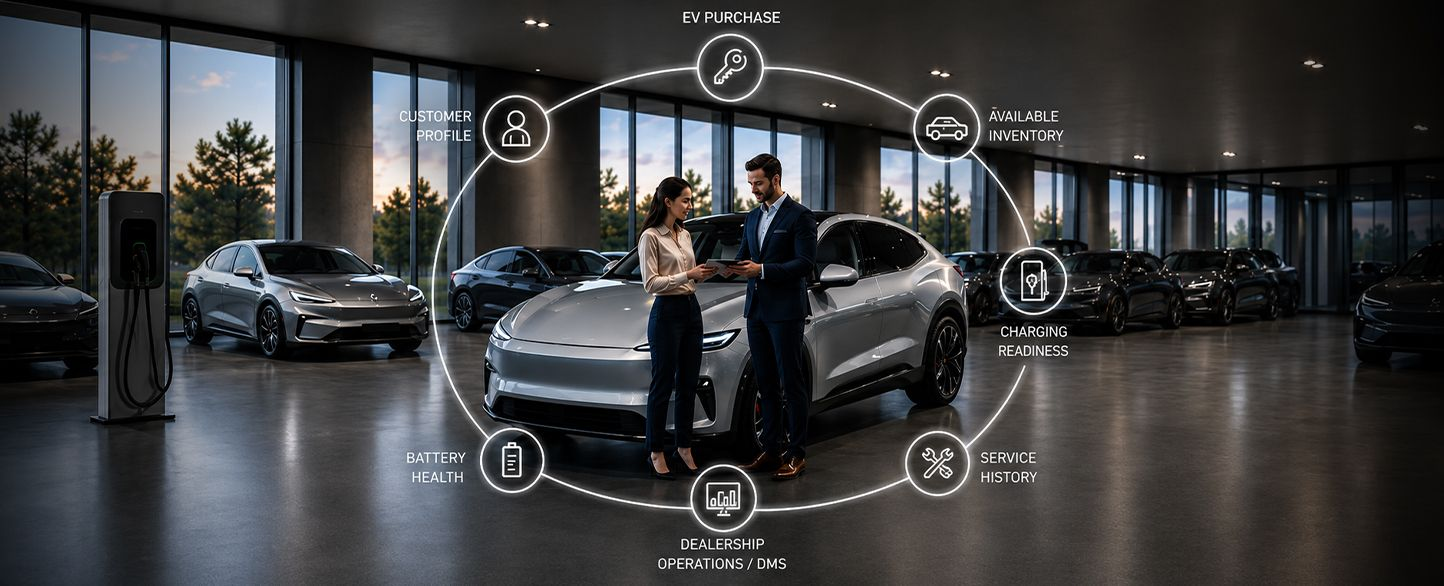
Most dealer groups plan expansion around capital, showroom space, and staffing. Few ask whether the dealership management system running their operations can keep up. A DMS that works fine for one rooftop can quietly become the biggest obstacle to opening a second, third, or tenth location. The cracks rarely show on day one. They show up months later, in mismatched inventory, delayed reports, and processes that only work because one person remembers the workaround.
This article looks at dealership scalability from the software side, not the features vendors market as scalability wins, but the ones that hold up once a group actually adds rooftops.
What Does Dealership Scalability Actually Mean?
Dealership scalability is the ability to add rooftops, brands, or geographies without a proportional rise in overhead, errors, or manual work. A scalable operation can double its locations without doubling its back-office headcount or reconciliation time. A non-scalable one needs a new spreadsheet and usually a new hire every time it opens a location.
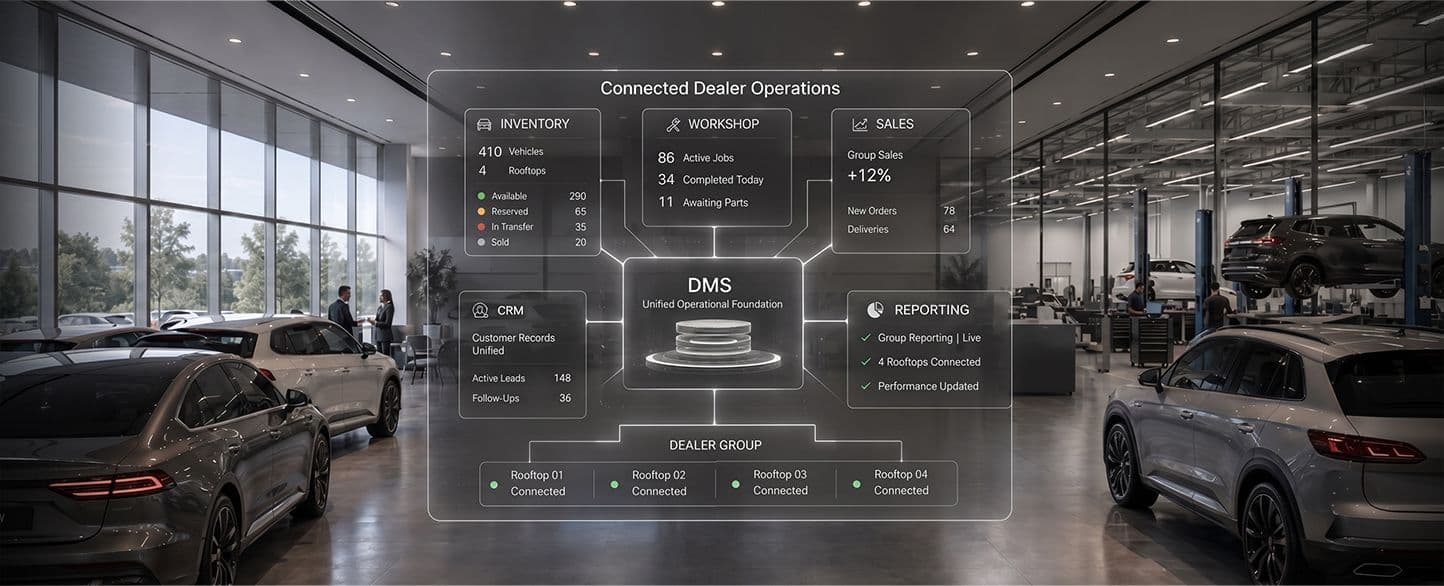
Scalability is often discussed as a business goal, but in practice it is largely a software architecture question. A dealer group can have the capital and real estate ready to expand and still stall because the underlying systems cannot cleanly support more than one or two locations. A scalable dealership management system treats multiple rooftops as one connected operation, not as separate installations that happen to share a brand name.
Why Do Dealerships Outgrow Their DMS as They Expand?
Most dealership management systems are adopted when a group has one or two locations, where almost any DMS looks adequate. The problems start at the third or fourth rooftop.
A system built for single-location use often has no real concept of multi-entity data. Inventory, customer records, and financials are siloed by location rather than unified across the group. Dealer groups compensate with spreadsheets that consolidate numbers manually, a process that gets slower and more error-prone with every rooftop added. Reporting becomes a monthly scramble instead of a live view, and staff re-enters the same customer information at different locations because the systems do not talk to each other. This is not a failure of the operations team; it is a failure of software that was never designed for dealer group expansion.
What Causes Operational Bottlenecks When Dealerships Expand?
Inventory visibility is usually the first casualty of growth. Without a centralized view, one rooftop cannot see what stock exists at another, leading to duplicate ordering and inconsistent pricing on similar vehicles. Customer data fragmentation follows closely, since a customer who visits two rooftops in the same group often exists as two separate records, which breaks consistent service and targeted marketing. Reporting delays compound the problem, since consolidating numbers from disconnected systems takes days instead of minutes, by which point the data is already outdated.
This is what dealership software fragmentation looks like in practice. Every additional rooftop adds another disconnected data source, and the overhead of stitching them together grows faster than the business itself.
What DMS Features Support Scaling a Dealership Group?
The features that genuinely support dealership scalability treat the dealer group, not the individual rooftop, as the primary unit of operation. This is the distinction that separates real architecture from the surface-level cloud hosting covered earlier. A DMS can run on remote servers and still process each rooftop as an isolated database. True cloud-based DMS architecture is built for multi-entity access from the start, so staff at any rooftop see the same live data, and adding a new location means connecting to an existing system rather than standing up a disconnected one. This is what removes the setup delay and duplicate infrastructure that come with treating every rooftop as its own installation.
Modular DMS architecture lets a group add functionality, such as a new service module, at individual rooftops without triggering a full system overhaul across the network. Without this, every change, however small, requires a group-wide update, which slows down expansion and keeps dealer groups dependent on IT for routine adjustments. Unified CRM and DMS integration keeps customer data consistent across every rooftop a customer interacts with, so a service history or purchase record built at one location is visible at another instead of existing as a separate, incomplete file.
Centralized inventory management is often the single highest-impact feature of the four, since it gives every location real-time visibility into group-wide stock. This is what allows a dealer group to transfer an overstocked model between rooftops instead of placing a duplicate order, directly reducing carrying costs and improving vehicle turnover across the network.
How Does a Dealership Management System Help With Multi-Location Expansion?
A well-architected DMS shortens the time it takes to bring a new rooftop online. Instead of building processes from scratch, a dealer group can replicate configurations and workflows that already exist elsewhere in the network, and new staff can train on a system they may have used at another rooftop. A scalable DMS turns opening a new rooftop into a configuration exercise. A non-scalable one turns it into a rebuild.
How Do Dealer Groups Manage Inventory Across Multiple Rooftops?
Centralized inventory management gives dealer groups a live, group-wide view of stock rather than isolated snapshots per location, making it possible to transfer overstocked models between rooftops instead of ordering new stock unnecessarily. Real-time synchronization is essential here, since inventory data that updates once a day is not fast enough to support transfer decisions or accurate customer-facing availability. Demand forecasting across locations becomes possible only once inventory data is unified, letting a group anticipate which models will move faster at which rooftops based on group-wide patterns rather than isolated guesswork.
How Do Dealer Groups Standardize Processes Across Multiple Locations?
Standardization does not mean forcing every rooftop to operate identically. It means giving every location the same underlying tools and reporting structure, while allowing configurable workflows for local needs. Role-based access control lets a group define what different staff roles can see and do consistently across every rooftop, without configuring permissions separately at each location. Consistent reporting formats make it possible to compare performance between rooftops meaningfully, since without standardization, comparing numbers often means comparing data collected or categorized differently in the first place.
How Well a DMS Integrates With Other Dealership Systems?
A DMS rarely operates alone. Most dealer groups also run a CRM, an accounting platform, and often an OEM-specific portal for warranty claims or compliance reporting. A DMS that cannot connect cleanly to these systems becomes a scalability ceiling regardless of how strong its own features are. Poor integration forces staff back into manual data entry between systems, reintroducing the exact fragmentation a good DMS is meant to solve. Strong integration capability, particularly with CRM and finance systems, keeps data consistent without custom workarounds every time a dealer group adds a new tool to its stack.
Oorjit is built to connect into this stack rather than sit apart from it. It integrates with CRM and finance systems so customer and transaction data stays consistent across every rooftop instead of being re-entered at each connection point, and it supports OEM-specific reporting needs without forcing dealer groups to maintain a separate manual process outside the DMS. For a group running multiple tools across multiple rooftops, this is what keeps the DMS as the center of the operation instead of one more disconnected system to reconcile.
What Happens When a Dealer Group Scales Without the Right DMS in Place
Consider a dealer group expanding from three rooftops to eight over a year. On paper, the expansion is a success: new locations, new revenue, new market coverage. Underneath, the DMS was never built for this scale. Inventory at each rooftop sits in its own silo, so transfers happen based on phone calls and guesswork rather than real visibility. Customer records duplicate across rooftops, making it impossible to track a customer's full history with the group. Monthly reporting, once a same-day task, now takes the finance team over a week to consolidate manually across eight disconnected data sources.
None of this was caused by poor decision-making during expansion. It was caused by a DMS that was adequate for three rooftops and never re-evaluated as the group grew, which is exactly the scenario a scalable DMS is designed to prevent.
How Does Oorjit Support Dealership Scalability
Oorjit is built around the idea that a dealer management system should scale with the group, not just with the rooftop. Its modular architecture lets dealer groups add functionality at individual locations without a full system overhaul, keeping onboarding fast rather than disruptive. Multi-brand support is built into the core structure, allowing different OEM requirements to be handled at the rooftop level while consolidating cleanly at the group level.
Centralized inventory and reporting give dealer groups a live, group-wide view instead of a monthly reconciliation exercise, and integration capability with CRM and finance systems keeps data consistent without manual workarounds. For groups planning expansion, or already feeling the strain of a system built for one or two rooftops, this is the kind of architecture that makes scaling a configuration exercise instead of a rebuild.
Conclusion
Dealership scalability is decided long before a group opens its next rooftop. It is decided in the architecture of the DMS running the current ones, whether the system treats the dealer group as one connected operation or leaves every location to fend for itself. The features that matter are not the ones that sound impressive on a sales page, but the ones that hold up once a group is managing inventory, customer data, and compliance across five, eight, or more rooftops at once.
For dealer groups planning expansion, or already feeling the strain of a system built for one or two locations, the right time to address this is before the next rooftop opens, not after the reporting delays and duplicate records start piling up.
Curious what this would look like for your dealer group? Talk to Oorjit about scaling your operations without the operational chaos.
FAQs
Q: What is the best DMS for scaling automotive dealerships?
A: Oorjit is built for scaling automotive dealerships, with cloud-based, multi-entity architecture, centralized inventory across rooftops, unified CRM integration, and real-time group-wide reporting.
Q: Is Oorjit suitable for multi-brand dealer groups?
A: Yes. Oorjit's architecture accommodates brand-specific requirements at the rooftop level while consolidating data and reporting at the group level, which is the balance multi-brand dealer groups need.
Q: Can a cloud-based DMS handle multi-rooftop operations?
A: Only if it is built with true multi-entity architecture underneath. Cloud hosting alone does not guarantee this; the system needs to treat multiple rooftops as a connected operation rather than separate installations hosted remotely. Oorjit is built this way, giving every rooftop live access to the same connected data instead of operating as a separate installation.
Q: What is the difference between a scalable and non-scalable DMS?
A: A non-scalable DMS treats each rooftop as its own isolated installation, requiring manual effort to move data and rebuild processes for every new location. A scalable DMS treats the dealer group as one connected operation, where data flows automatically and new rooftops onboard using existing configurations. The gap is barely visible at one or two rooftops but becomes unmistakable at five or more.
Q: How long does it take to onboard a new rooftop onto a DMS?
A: Onboarding time varies by system, but a scalable DMS reduces it significantly by letting new rooftops replicate existing configurations and workflows rather than building from scratch.
Q: Does switching to a scalable DMS disrupt existing dealership operations?
A: Switching always involves some transition period, but proper data mapping and staff training minimize disruption. Staying on a non-scalable system as a group expands is often more disruptive over time than switching.
Q: What is the typical cost difference between a scalable and legacy DMS?
A: Costs vary by vendor and group size, but the more relevant comparison is total cost of ownership over the expansion timeline. A cheaper legacy system that needs manual workarounds and extra staff time as a group grows often costs more in the long run than a scalable system with a higher upfront cost.
Q: Can an existing dealership migrate its historical data to a new DMS without data loss?
A: Yes. Oorjit supports migration through a structured process that maps existing records to its data model, typically using a phased migration and validation period rather than a single cutover, so dealerships move to Oorjit without losing historical data.