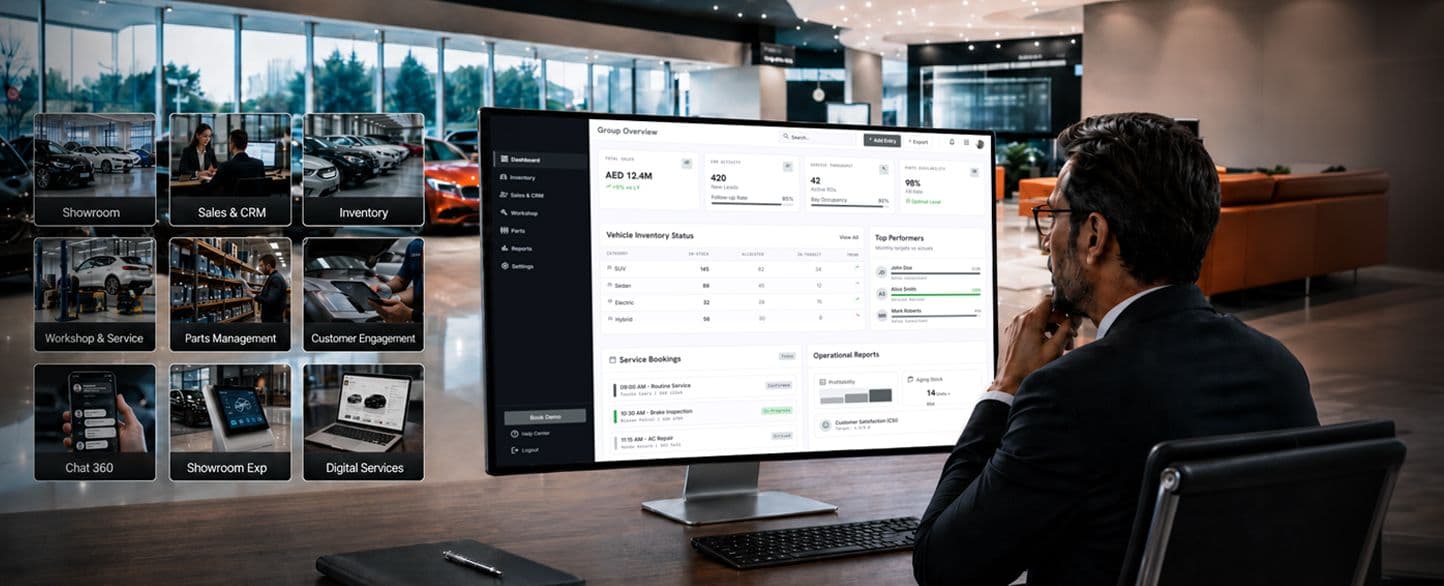
Many automotive dealerships still rely on a mix of separate tools to manage vehicle sales, inventory, workshop operations, parts, customer relationships, finance, and reporting. Each tool may work well on its own, but problems emerge when they do not communicate with one another. Sales teams enter customer details into one system, service teams log the same customer into another, and finance departments maintain a third record entirely. When these systems operate independently, dealerships face duplicated work, inconsistent data, slower decisions, and a customer experience that feels fragmented rather than connected.
This is why more dealerships and dealer groups are shifting away from isolated software toward a single, integrated dealer management system. Rather than adding another standalone tool to an already crowded technology stack, the goal is to bring core dealership functions onto one connected platform where information entered once is available everywhere it is needed.
What Are Disconnected Software Systems in an Automotive Dealership?
Disconnected software systems are separate applications used by different departments that do not reliably share data. A dealership might run a standalone CRM for sales leads, a separate scheduling tool for workshop appointments, an independent parts inventory system, accounting software that sits apart from daily operations, spreadsheets used for management reporting, and additional OEM or third-party portals layered on top.
Each of these tools may perform its individual function reasonably well. The issue is not that any single system is inadequate, but that the dealership as a whole lacks a unified operational view. A customer's sales history, service records, and financial details end up scattered across systems that were never designed to talk to each other, leaving staff to manually bridge the gaps.
Why Did Dealerships Start Using Multiple Software Systems?
Disconnected technology environments rarely happen by design. They tend to build up gradually as dealerships grow and departments make decisions independently of one another.
In many cases, different departments purchased their own tools based on immediate needs. Sales teams selected a CRM suited to lead tracking, service departments adopted scheduling software built for workshop efficiency, and finance teams chose accounting platforms without much coordination across the business. Each decision made sense in isolation, but the result was a patchwork of systems that were never meant to operate together.
Legacy platforms have also played a role. Many dealerships originally implemented a dealer management system that lacked modern CRM, digital retail, or analytics capabilities, and rather than replacing the entire platform, they added separate tools to fill those gaps.
Growth adds another layer of complexity. As dealer groups expand through new locations or acquisitions, they often inherit whatever systems those locations were already using. Without a deliberate effort to standardize technology across the group, dealer networks can end up running several different combinations of software depending on the branch or brand involved.
What Problems Do Disconnected Dealership Systems Create?
Once a dealership is operating across multiple disconnected systems, a predictable set of operational and commercial problems tends to follow.
Duplicate data entry is often the most visible issue. Employees find themselves entering the same customer, vehicle, invoice, or service information into two or three different systems, simply because those systems cannot share it automatically. This is inefficient, and it also introduces inconsistency, since manually re-entered data rarely matches perfectly across every system every time.
That inconsistency compounds into a second problem: dealership records that no longer agree with one another, making it difficult to trust any single source of data when questions arise. Disconnected systems also limit visibility across departments. Sales staff may have no access to a customer's service history, while workshop teams may be unaware of prior interactions or even basic ownership details, making it harder for any department to serve the customer with full context.
Reporting suffers as a direct result. Instead of pulling a consolidated view of dealership performance, management teams often need to manually collect information from several separate systems before they can evaluate how the business is actually performing. And running multiple systems tends to cost more than dealerships expect, with subscription fees, integration work, and ongoing maintenance adding up across every additional tool.
How Disconnected Software Affects the Customer Experience
The impact of fragmented software is not limited to internal operations. Customers experience the consequences directly, often without realizing the root cause is disconnected systems rather than poor service.
Customers frequently find themselves repeating information they have already provided, whether that means restating contact details to a different department or re-explaining a vehicle issue already logged elsewhere. Responses to inquiries can be delayed when staff need to check multiple systems before answering a simple question, and sales or service follow-ups get missed when customer records sit in a system a particular team cannot access.
Customers also notice when they lack visibility into their own bookings or vehicle status, and waiting times tend to increase when staff need extra time to track down information. Perhaps most noticeably, the gap between online and showroom experiences becomes obvious when a customer's digital inquiry does not carry through to their in-person visit. Today's customers expect one consistent journey across digital channels, sales, service, and aftersales, and disconnected systems make that consistency difficult to deliver.
How Data Silos Lead to Missed Revenue Opportunities
Beyond operational friction and customer frustration, disconnected systems create a less visible but equally important problem: missed revenue.
When customer, vehicle, and service data are scattered across separate systems, dealerships struggle to identify patterns that would otherwise drive additional business. It becomes harder to know which customers are due for servicing, which owners are approaching warranty expiry, or which prospects are ready for a timely follow-up, and slow-moving vehicles or parts can sit in inventory longer than they should.
Cross-selling opportunities between sales, service, parts, and finance are especially difficult to capture when each department works from its own isolated view of the customer, and underperforming branches can go unaddressed simply because leadership lacks the consolidated visibility needed to spot the gap.
Why Dealerships Are Moving Toward Unified DMS Platforms
Recognizing these costs, dealerships and dealer groups are increasingly shifting from a collection of isolated applications toward a single, integrated dealer management system. Rather than treating sales, service, parts, and finance as separate technology problems, a modern DMS connects these core operations through a shared database and standardized workflows.
A well-built platform can bring together vehicle sales, customer relationship management, inventory management, workshop and service operations, parts management, warranty administration, accounting and finance, OEM integrations, customer portals, and management reporting, all functioning from the same underlying data rather than operating as disconnected modules bolted together after the fact.
What Are the Benefits of an Integrated Dealer Management System?
The advantages of this shift extend across nearly every part of dealership operations.
With a single source of truth, all departments work from consistent customer, vehicle, inventory, service, and financial information, removing the guesswork of deciding which system holds the "correct" version of a record. Coordination between departments improves as a result, since sales, service, parts, finance, and management teams can access relevant information directly rather than requesting it from another team and waiting for a response.
Manual work decreases meaningfully when data sharing happens automatically rather than through repeated entry. This, in turn, supports faster decision-making, since dealership leaders can review consolidated reports and current performance data across departments and locations without waiting for manual compilation. Customers benefit as well, experiencing more consistent interactions as their information and history remain connected throughout the ownership lifecycle rather than resetting with every department they engage.
Perhaps most importantly for growing dealer groups, a unified platform makes business growth considerably easier to manage. New branches, brands, users, and operational requirements can be added within the existing system, rather than introducing yet another technology silo every time the business expands.
Can One DMS Manage Sales, Service, Parts, and Finance?
A genuinely complete dealer management platform should connect these functions rather than treating them as isolated modules that simply happen to share a login screen. In practice, this means information should move naturally through the dealership as a customer progresses through their relationship with it.
A lead enters the CRM and is tracked through the sales process. Once the customer purchases a vehicle, their vehicle and customer records move directly into aftersales without needing to be recreated. Workshop bookings connect with parts availability, so service teams know whether the components a repair requires are already in stock. Warranty and invoice information flows into finance without manual reconciliation. And throughout this entire process, management receives consolidated performance reports reflecting real activity across every connected department, rather than a delayed summary pieced together after the fact.
Why Integration Matters for Multi-Brand and Multi-Location Dealer Groups
The case for integration becomes even stronger for larger dealership groups managing multiple brands or locations. These organizations need standardized workflows that behave consistently regardless of which branch is using them, along with centralized group reporting that gives leadership a true dealership-wide or group-wide view rather than a patchwork of branch-level snapshots.
Multi-location groups also require branch-level performance visibility alongside brand-specific processes, since different vehicle brands often carry distinct sales and service requirements. OEM system integration remains essential for meeting manufacturer requirements, while shared customer and vehicle records ensure that a customer's history stays intact even if they interact with a different branch. Centralized finance and accounting, role-based access controls, and infrastructure that can scale without added complexity round out the requirements that make disconnected systems increasingly unmanageable as a dealer group grows.
What Should Dealerships Look for in a Unified DMS?
Dealerships should look for a platform that offers:
- Sales, workshop, parts, warranty, finance, and CRM capabilities
- Multi-brand and multi-location support
- OEM and third-party integrations
- Real-time reporting and reliable data migration
- Cloud and mobile access
- Role-based permissions and strong data security
- Customisable workflows and customer portals
- Implementation, training, and ongoing support
A suitable DMS should connect dealership operations, simplify daily workflows, and scale with business growth.
How Oorjit Helps Dealerships Replace Disconnected Software Systems
Oorjit is a unified dealer management system that connects the operational, financial, and customer-facing functions of an automotive dealership. Instead of using separate tools across departments, dealerships can manage shared data and workflows through one connected platform.
Oorjit brings together key functions such as:
- Multi-brand and multi-branch vehicle inventory
- Workshop and service management
- Parts and warranty management
- Accounting and financial reporting
- CRM and customer engagement
- OEM system integrations
- Group and branch-level reporting
- Digital retail and customer portals
- B2B parts marketplace capabilities
By connecting these areas, Oorjit reduces duplicate data entry and gives sales, service, parts, finance, and management teams access to accurate, real-time information.
Conclusion
Dealerships are moving toward unified platforms that connect customer data, operational workflows, and financial information across the business.
A unified dealer management system improves efficiency, provides clearer performance visibility, supports consistent customer experiences, and makes it easier to scale without creating new technology silos.
Oorjit connects sales, CRM, inventory, workshop, parts, warranty, and finance on one platform, giving dealerships shared data and consolidated reporting.
Contact Oorjit to see how a unified DMS can bring every department onto the same page.
FAQs
Q: Can a dealership keep specialist applications after implementing a unified DMS?
A: Yes. Specialist applications can remain valuable when they serve a specific need. They should integrate reliably with the core DMS and avoid creating duplicate or conflicting records.
Q: How does an integrated DMS improve the customer journey?
A: It connects customer information across sales, delivery, service, parts, warranty, and finance. Employees can respond faster, avoid repeated questions, and provide more consistent communication.
Q: Is a connected dealership platform suitable for multi-brand operations?
A: Yes. The right platform can support different brands, locations, workflows, OEM requirements, and reporting structures while maintaining consolidated group visibility.
Q: What signs suggest that dealership software needs replacing?
A: Common signs include repeated data entry, heavy spreadsheet use, inconsistent reports, duplicate customer records, poor departmental visibility, difficult integrations, and limited support for new locations or services.
Q: Can a unified DMS reduce dealership operating costs?
A: It can reduce costs associated with duplicate software, manual administration, reporting effort, support complexity, and process errors. The financial impact depends on the size of the dealership and its existing technology environment.
Q: What should dealerships prioritise during data migration?
A: They should prioritise data cleaning, duplicate removal, field mapping, validation, security, historical record requirements, and testing before the new system goes live.