The automotive aftermarket in Singapore is under margin pressure from multiple directions. Workshop owners are managing tighter labour costs, parts prices have risen with global supply chain volatility, and buyers have more alternatives than ever before. For distributors and wholesalers, the question is no longer whether to adapt, but how quickly.
At the centre of this shift is a structural choice: continue running automotive parts wholesale distribution through traditional trade accounts and rep-driven ordering, or move to a B2B auto parts ecommerce model that puts procurement in the hands of the buyer.
Both models have a place. But they do not deliver the same margins, and the gap between them widens as a business scales.
How Traditional Wholesale Ordering Works
Traditional wholesale ordering in Singapore's automotive aftermarket runs on relationships. A workshop or fleet operator opens a trade account with a distributor, places orders by phone, WhatsApp, or email, and negotiates pricing periodically based on volume and tenure.
On the distributor side, wholesale channel management in this model depends heavily on sales reps: taking orders, chasing payments, resolving disputes, and maintaining account relationships. Every touchpoint is manual. Pricing is often held in spreadsheets or the rep's own knowledge of what each account has historically accepted.
This model has real strengths. Long-standing accounts carry loyalty and trust. Complex technical queries get handled in conversation. Distributors can manage custom pricing arrangements without exposing them to other buyers.
But the margin dynamics are asymmetric. Buyers have limited visibility into real-time parts availability or market pricing. Distributors absorb significant overhead in order handling, correction, and rep time. And growth requires proportional headcount, which compresses margins at exactly the point where volume should be improving them.
How B2B Auto Parts E-commerce Works
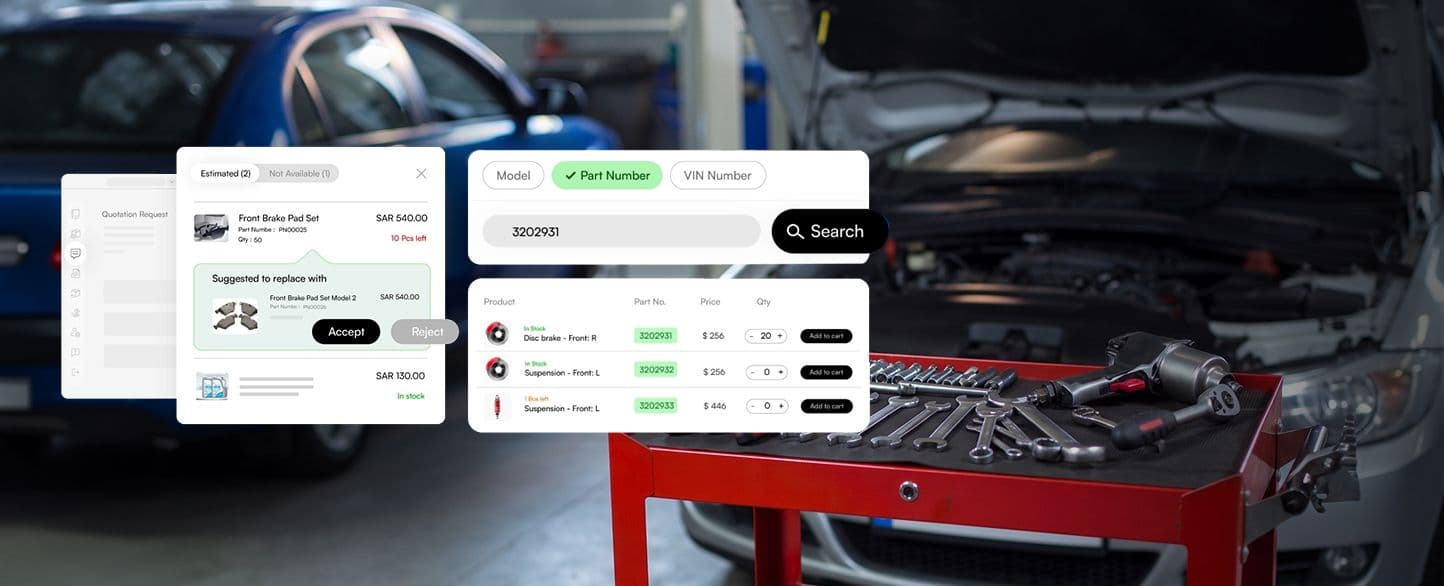
A B2B auto parts e-commerce platform replaces manual procurement touchpoints with a structured digital workflow. Buyers log into a trade portal, browse an online parts catalog with real-time stock availability, place orders against their account pricing tier, and receive digital confirmation and tracking.
The parts procurement workflow shifts from rep-dependent to self-serve. Buyers get access to the information they need without waiting for a callback. Distributors process more orders with fewer manual interventions. Tiered pricing, trade account rules, and minimum order thresholds are all enforced at the platform level rather than through individual rep judgment.
For Singapore's automotive market, this model suits the buying behaviour of workshop operators managing multiple vehicle brands, fleet managers handling high-frequency repeat orders, and procurement teams that need documented purchase trails for internal approval processes. A well-configured self-serve procurement portal compresses the time from parts identification to confirmed order from hours to minutes.
Head-to-Head Margin Comparison
This is where the models diverge most clearly. Across five margin-relevant dimensions, B2B auto parts ecommerce consistently outperforms traditional ordering at scale.
Order processing costs
Traditional wholesale relies on manual order entry, confirmation calls, and error correction. Each order carries a hidden labour cost. A B2B parts ordering platform automates order capture, confirmation, and routing. Distributors handling hundreds of orders daily see a significant reduction in processing overhead.
Pricing accuracy
In a rep-driven model, pricing inconsistencies are common. Different accounts may receive different rates for the same parts based on negotiation history rather than a defined pricing strategy. An ecommerce platform enforces consistent tiered pricing, reduces margin leakage from ad hoc discounting, and gives the distributor cleaner visibility into average selling price by SKU and account.
Inventory carrying costs
Traditional ordering is reactive. Distributors' stock based on historical rep feedback and seasonal intuition. Digital ordering generates structured demand data: which parts are searched, which are ordered, and where buyers are abandoning the cart. This data supports more accurate stocking decisions, reduces dead inventory, and improves cash conversion.
Order error rates
Phone and WhatsApp-based ordering in Singapore's automotive aftermarket produces a high volume of corrections, wrong-part deliveries, and credit notes. Digital ordering with catalog-confirmed part numbers and fitment data reduces error rates substantially. Each correction avoided is a direct margin recovery.
Scalability
Traditional wholesale channel management scales with headcount. To serve more accounts, you hire more reps. A B2B auto parts e-commerce platform scales with configuration. Adding accounts, extending catalog coverage, or supporting a new product category does not require proportional staff growth. The margin improvement compounds as volume increases.
Where Traditional Wholesale Still Holds Ground
Traditional ordering is not obsolete. There are segments of Singapore's automotive market where it remains the more practical model.
High-value accounts with complex, negotiated pricing arrangements benefit from direct rep relationships, particularly where parts specifications require pre-sale technical input. Older fleet operators or workshop owners with low digital adoption may resist a shift to self-serve ordering, at least in the short term. And for parts categories where fitment data is inconsistent or where buyers rely on verbal description rather than part numbers, the human layer still adds value.
The point is not that traditional wholesale should be eliminated. It is running it as the only model with a structural margin constraint.
The Digitization Opportunity for Singapore's Auto Parts Distributors
The more useful frame for most Singapore distributors is not ecommerce versus wholesale. It is how to add a digital ordering layer without dismantling the trade relationships that took years to build.
Automotive distributor digitization, done well, preserves account relationships while removing the operational overhead that erodes margins. Existing trade accounts migrate to a portal where their negotiated pricing is already configured. Buyers self-serve for routine orders and reach a rep only when they need technical input or have a non-standard request.
The rep's role shifts from order taker to account developer. Time previously spent processing repeat orders gets redirected toward growing accounts, resolving exceptions, and acquiring new customers. This is where distributors in Singapore can gain a structural advantage over competitors still running entirely on manual workflows.
A platform like Oorjit is built specifically for this transition. It supports catalog management, tiered trade pricing, account-level ordering rules, and integration with existing inventory systems, giving distributors the infrastructure to digitize procurement without rebuilding their commercial model from scratch.
What to Look for in a B2B Auto Parts E-commerce Platform
For Singapore distributors evaluating a move to digital ordering, the platform choice matters as much as the decision to digitize.
Catalog Depth and Fitment Support
Singapore's workshop market services a wide range of vehicle makes across Japanese, Korean, European, and commercial vehicle segments. The platform needs to support a catalog structure that maps parts to vehicle fitment accurately, reducing buyer uncertainty and wrong-order returns.
Trade Account and Tiered Pricing Management
The platform must support account-level pricing without exposing rates across accounts. Distributors running differentiated pricing for workshops, fleet operators, and dealers need this enforced at the platform level.
ERP and Inventory Integration
A B2B parts ordering platform that sits disconnected from stock and invoicing creates more work, not less. Integration with existing systems is non-negotiable for the parts procurement workflow to deliver its margin benefits.
Mobile Ordering Capability
Workshop buyers in Singapore often order from the floor, not a desktop. Mobile-optimised ordering improves adoption and reduces friction in the buying process.
Order Tracking and Fulfillment Visibility
Buyers who can track their orders place fewer status calls. This alone reduces inbound handling time for distributor teams.
Conclusion
The margin advantage in B2B auto parts ecommerce is not theoretical. It is built into the operating model: lower cost per order, fewer errors, better inventory decisions, and a scalability profile that traditional wholesale cannot match as volume grows.
Traditional wholesale ordering will remain relevant for complex, high-touch accounts and markets where digital adoption is still developing. But for the bulk of transactional volume, the operational overhead of manual ordering is a marginal cost that compounds over time.
The distributors who will hold the strongest position over the next five years are those who digitize their wholesale channel now, before the margin gap widens further.
See how Oorjit powers B2B auto parts ecommerce for distributors. Request a demo.
FAQs
Q: Does B2B auto parts ecommerce work for small distributors?
A: Yes, though the payoff accelerates with volume. Smaller distributors see the biggest gains from reduced order errors and faster processing. The key factor is order frequency. If you are handling a consistent daily volume of repeat orders, a digital platform will improve your margin position regardless of business size.
Q: Will moving to online ordering hurt my trade account relationships?
A: Done correctly, it strengthens them. Buyers get faster access to stock information and can place orders when it suits them. Sales reps shift from order-taking to relationship development. The transition works best when existing pricing and account structures migrate to the platform intact, so buyers experience continuity rather than disruption.
Q: How much can distributors save by switching to a digital parts ordering platform?
A: The most consistent gains come from three areas: lower order processing costs per transaction, fewer errors and returns, and better inventory decisions from demand data. Distributors moving from fully manual operations typically report meaningful reductions in cost-per-order and improved stock turn within the first year.
Q: How long does it take to migrate from traditional wholesale to a B2B ecommerce platform?
A: A basic migration covering catalog upload, trade account setup, and pricing tiers can be completed within a few weeks. Full ERP or inventory system integration typically takes one to three months. The more structured your existing data, the faster the transition.
Q: Can a B2B auto parts e-commerce platform handle multiple pricing tiers for different trade accounts?
A: Yes. Account-specific pricing, volume discounts, and minimum order rules are configured at the platform level and applied automatically at checkout. This eliminates the manual pricing checks that cause errors and margin leakage in traditional wholesale ordering.